






More than two decades after it premiered, HBO’s Rome has still not been matched, and that should embarrass everyone who has tried since. Studios have thrown nine-figure budgets and an ocean of pixels at the swords-and-sandals genre, and none of it has produced an ancient world as filthy, loud and lived-in as the one this show built in 2005 and was forced to abandon in 2007. Rome lasted just two seasons and twenty-two episodes before its price tag killed it. It was planned for five. Even cut short, and even with a second season that stumbles in places, it remains the high-water mark of Roman drama on television. Here is why.
Two Soldiers and One Collapsing Republic
Rome was created by Bruno Heller, William J. MacDonald and John Milius, and co-produced by HBO, the BBC and Italy’s RAI. Its masterstroke was to tell the death of the Roman Republic through two ordinary soldiers, Lucius Vorenus (Kevin McKidd) and Titus Pullo (Ray Stevenson RIP). The names come from a pair of centurions mentioned in Caesar’s own writings, but the men we follow are inventions, and they stumble into nearly every major event of the era like the unluckiest tourists in history.
Some people object to fictional characters in historical drama. Those people clearly haven’t watched much television. Inventing ordinary people to walk through real events is one of the oldest tricks in the genre, because it gives the audience a pair of eyes at ground level while the famous names do their scheming in marble halls. The trick only goes wrong when the invention starts rewriting what we actually know. Rome stays largely on the right side of that line, and that distinction matters later in this review.

Season One: Where the Show Earns Its Reputation
Season One is the stronger of the two, and the reason is simple: it is better fleshed out. Twelve episodes carry us from Caesar’s civil war in 49 BC to his murder, which gives the writers enough room to build everyone properly: the generals, the senators, the women who really run the city, and the two soldiers caught in the middle. Nobody is a cardboard cutout, the politics land because you understand who wants what, and the world feels crowded rather than staged.
And then there is the finale. Kalends of February is one of the best episodes the series ever produced. The title echoes the Ides of March, the day Caesar was actually killed, and the episode spends its runtime pulling toward that moment. Brutus, the man Caesar treats like family, is drawn into a plot with his mother Servilia, Cassius and others, and then the senate floor turns into a slaughterhouse. By the time the knives come out, the episode has made you care about the victim as much as the killers, which is exactly what a political assassination needs in order to hurt.

Season Two: Bigger Stakes, Smaller Room
Season Two opens with Caesar dead and Rome fighting over the carcass. Its ten episodes follow the rivalry between Mark Antony and Octavian through Cleopatra’s arrival in the capital and the fallout from the Battle of Actium, ending with Octavian’s triumph. The production values hold up, and so do the big historical beats.
The problem is time. One account says the cancellation arrived midway through production of Season Two, which forced the writers to cram more than a decade of events into ten episodes. I can forgive a cramped timeline. What I can’t forgive is where the time went. A hefty chunk of it was spent on Vorenus and his family, and in particular the gang-captain plot, in which he ends up running a criminal crew with Antony’s blessing while his children are in danger. It is a detour, and it eats runtime that Antony and Octavian’s story badly needed. I am not alone in this: Slant Magazine’s review of the season said the show had drifted and that its once well-drawn characters had turned repetitive, and the Rotten Tomatoes critics’ consensus makes a kinder version of the same complaint.
Even at its weakest, though, Season Two still looks and sounds like a drama that cares about its world, which is more than I can say for most epics made since.

The Sets: A City Built, Not Rendered
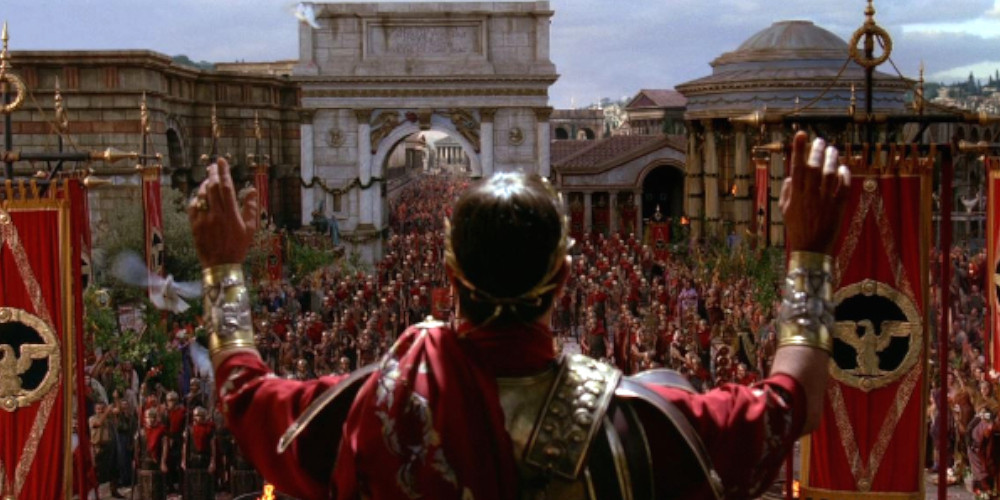
Take the sets first, because they are half the reason the show works. The production moved into Cinecittà, the famous Italian studio outside Rome, and built an entire city there. Guinness World Records lists it as the largest set ever made for a TV programme: about five acres of outdoor backlot, six soundstages, a Forum at roughly 60 percent of the real thing’s scale, and a Sacred Grove planted with olive trees more than two centuries old. Work started in November 2003 and wrapped in March 2004, well before a single frame of Season One aired.
What mattered more than the size was the look. This Rome has no gleaming white marble. Temples are painted in loud colours, walls are scrawled with graffiti, tenements climb several storeys, and the streets are grimy, crowded and noisy. It is a city that looks used, and it is far more convincing than the pristine postcards older epics sold us. Yes, walk behind some of those facades and you would find fibreglass, because that is how sets work. What counts is what the camera sees, and the camera saw a city where people actually lived.


The Costumes: Four Thousand Pieces and No Plastic Armour
Costume designer April Ferry and her team turned out more than 4,000 costumes in natural fibres, dyed in-house at the studio. You can read status from across the Forum: the powerful are dressed to show their rank, while ordinary Romans wear clothes that look as if they have been worked in. The effort paid off. Ferry won an Emmy for the episode Triumph, and the series took four Emmys at the 2006 ceremony, including art direction and costume design.
Natural fabrics matter more than you would think. They move differently, they crumple differently, and they age on screen the way real clothes do. That texture is exactly what disappears when a modern epic dresses everyone in pristine, computer-polished armour.


The Acting: Where Rome Goes From Impressive to Unforgettable
Ciarán Hinds is the heart of Season One as Julius Caesar. He plays a man whose authority is never in doubt, which is exactly why the finale stings: you lose the performance along with the character.
James Purefoy as Mark Antony and Tobias Menzies as Brutus are the other two performances I would single out. Purefoy gives Antony swagger and appetite, and Menzies gives Brutus the look of a man who knows what he is about to do and goes through with it anyway, which is what makes him the conflicted centre of that finale. The two leads are solid. Kevin McKidd and Ray Stevenson have to be, because the show’s entire invented spine rests on their chemistry. Remove that and the whole walk through history collapses. The wider cast, including Lindsay Duncan as Servilia and Polly Walker as Atia, fills out a world where even the small parts feel lived in.
The weak link, for me, is the young Octavian of Season One. Max Pirkis plays him as whiny, and while a spoiled teenage heir might reasonably be whiny, it makes it hard to picture the calculating man he is supposed to become. Simon Woods takes over the role in Season Two.


Why Nobody Builds Them Like This Anymore
So why hasn’t anyone built another one? Three things.
First, the CGI. Ridley Scott’s Gladiator II arrived in 2024 with computer-generated baboons and, in a flooded Colosseum, sharks. Many reviewers were unkind to the digital animals, and when critics questioned the historical accuracy of the shark scene, Scott’s reply was that they were wrong. When everything on screen is rendered, nothing in it can bleed.
Second, streaming bloat. Amazon’s The Rings of Power cost a reported $465 million for its first eight episodes, around $58 million an episode, among the most expensive in TV history by most accounts. That total includes start-up costs for sets and costumes meant to last several seasons, so treat it with care. Even so, Rome’s first season cost about $100 million for twelve episodes, and that was in 2005 money, while House of the Dragon’s first season reportedly came in under $20 million an episode. I am not claiming money is the enemy; the sets of Rome were not cheap. But a bigger budget does not buy a bigger sense of place, and the streaming era has too often treated cost as a substitute for craft.
Third, the way modern productions treat history itself. I have no objection to invention; I just praised Rome for it. My objection is to invention that ignores what we know and still borrows the authority of history. Netflix’s Vikings: Valhalla cast Caroline Henderson as Jarl Haakon, a fictional ruler loosely inspired by the historical Haakon Sigurdsson, in a series that Smithsonian describes as heavily reshuffling its sources. I found no source documenting a Black woman ruling a Norse territory. Viking-age Scandinavia was more mixed than the cliché suggests, and a 2020 study in Nature of 442 Viking-age genomes found plenty of non-Scandinavian ancestry, but mixed ancestry across a trading world is a long way from an unevidenced ruler. Fiction can invent, but it should at least be plausible inside the world it borrows.

Netflix’s Queen Cleopatra is the stronger example, because it is a docudrama with historians speaking on camera, a format that makes truth claims. It cast Adele James as the last queen of a dynasty founded by a Macedonian Greek general. An Egyptian lawyer filed a complaint over the casting, and the Egyptologist Zahi Hawass publicly objected to the portrayal. Netflix pointed to the long-running debate about her heritage, and producer Jada Pinkett Smith said she wanted to tell the stories of Black queens. That is a stated aim, and a fair one on its own terms, but a poor fit for a format that presents itself as history. Rome, for the record, kept its inventions at the level of ordinary soldiers and left the famous names to follow the record.
HBO’s own House of the Dragon is a different case, because there is no historical record in Westeros to contradict. The argument there is about the books, and even that is murkier than it looks. The silver hair of the Velaryons matches the page; the dispute is over skin tone, and sources disagree on whether Martin’s text states it. Showrunner Ryan Condal says the casting was not done to tick a box, that Martin once considered making the Velaryons Black with silver hair, and that it helps viewers tell the great houses apart on screen. That is a fair defence as defences go. I would still rather an adaptation stuck closer to the page.
My rule is simple: invent freely, invent plausibly, and do not rewrite documented fact while teaching it. Rome invented two soldiers. It did not invent a new Caesar.

Rome Versus Thrones
Fans will say the real comparison is Game of Thrones, HBO’s other great epic, and fair enough, but that comparison actually helps Rome. The final season of Thrones is the worst-received season of its own run, sitting at roughly 55 percent with critics and 30 percent with audiences on Rotten Tomatoes and standing as the only season to land in Rotten territory. Rome never got the chance to throw away a world it had spent years building. It was cut short, but it was cut short with a coherent ending at Actium. A drama that ends too soon is a loss. A drama that ends badly spoils what came before.
JAY’S VERDICT

Rome is imperfect, and I will say so plainly: Season Two wastes time on Vorenus’s gang-captain detour, and Octavian’s whiny teenage years in Season One test the patience. But the sets, the costumes and the performances from Ciarán Hinds, James Purefoy and Tobias Menzies make this the benchmark for Roman drama on television. Two decades of CGI baboons, bloated budgets and history by press release later, nothing has beaten it.
Watch Season One for the politics, endure Season Two for Actium, and ask yourself why the people making these shows keep forgetting that a world you can believe in beats a world you can render.


