




INTRODUCTION
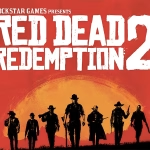
Let me tell you something about Red Dead Redemption 2 that most reviews will not tell you.I am writing about a game that came out in 2018. Eight years ago. In gaming terms, that is practically the Stone Age. We have had entire console generations, a global pandemic, and roughly four hundred battle royale games since then. And yet, not a week goes by — genuinely, not a single week — where I do not think about this game. Where I do not wish I could reach back in time, wipe my own memory clean, and experience it for the first time again. That is not nostalgia. Nostalgia is what I feel about the original Tony Hawk’s Pro Skater. This is something else.
This is the specific, low-grade grief of knowing you have already had the best version of an experience and can never get it back. Red Dead Redemption 2 is Rockstar Games’ follow-up to Red Dead Redemption — a critically acclaimed open-world Western set in the dying years of the American frontier. The original game was beloved. Its protagonist, John Marston, was our guy. Grizzled, scarred, quietly honourable, with a face like a man who had made every wrong decision twice and was still standing. When Rockstar announced the sequel, we assumed — reasonably — that we would be playing as John again. More frontier. More outlaws. More riding across beautiful landscapes while a haunting acoustic guitar track played in the background. What we got instead was Arthur Morgan.

This is not a review in the conventional sense. I am not going to tell you whether to buy it — you should, obviously, that conversation is over. This is something more personal: my attempt to articulate why this game lives in my head rent-free nearly a decade later. Why Arthur Morgan, a fictional outlaw who died of tuberculosis in 1899, is one of the most fully realized characters ever put into a piece of interactive fiction. And why, if you played this game and felt nothing when the sun came up at the end — I am genuinely, sincerely worried about you.
So. Let’s ride into the dying world of outlaws.
MEET THE VAN DER LINDE GANG
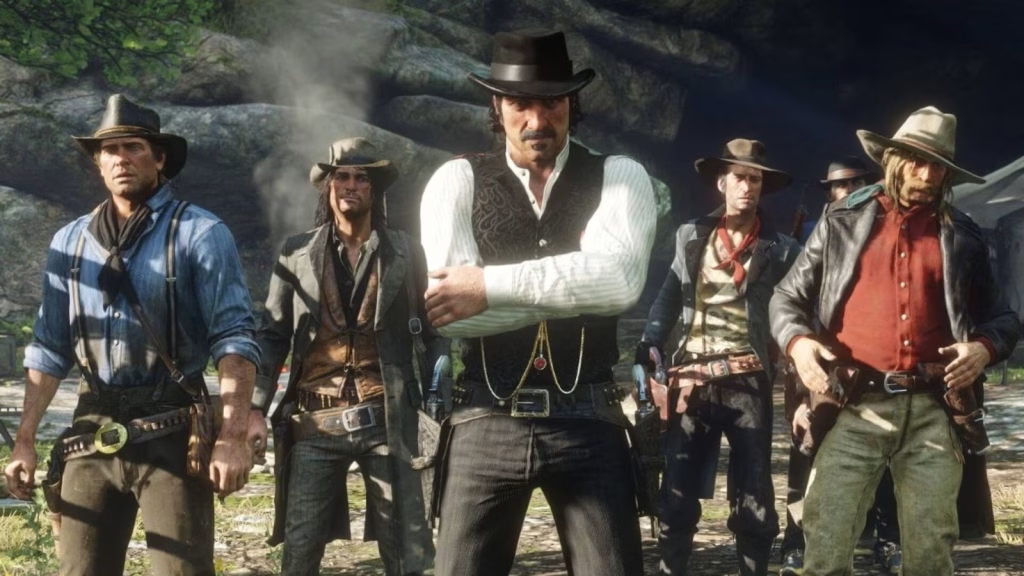
Before we get into the plot, let’s meet the gang’s members and get a brief understanding of these characters as all of these characters play a huge role as the plot develops and in Arthur’s redemption arc.

Arthur Morgan is Dutch van der Linde’s lead enforcer — the blunt instrument the gang reaches for when things need doing and questions need not be asked. Dutch found him at 14, a street kid with no parents, no prospects and enough rage to fill a county. Most men would have written him off. Dutch saw something else. With structure, loyalty and a sense of purpose, that angry delinquent became Dutch’s most capable and dedicated soldier. Arthur is sharp, cool-headed and utterly ruthless when the situation demands it — but he operates by his own code, even when that code quietly contradicts everything the gang stands for. He is the primary playable character in RDR2, and the game’s redemption arc belongs entirely to him.

John Marston is the second playable character in RDR2, though his time doesn’t come until the Epilogue. Most players will already know him as the lead of the original Red Dead Redemption. His story mirrors Arthur’s in the broad strokes — Dutch pulled him out of a lynching when he was a boy, gave him a gun and a gang, and turned him into an outlaw. John and Arthur grew up side by side in the van der Linde gang, surrogate brothers in everything but blood, and Dutch’s two proudest protégés. He has been with Abigail Roberts for years, though their relationship — like most things in John’s life — has never been uncomplicated.

Dutch van der Linde is the founder, leader and ideological engine of the gang — a man who genuinely believed, for most of his life, that he was something more than an outlaw. He and Hosea Matthews found each other in the mid-1870s when Hosea tried to rob him at a campfire and discovered Dutch had already returned the favour. They laughed, partnered up, and built something out of nothing. Dutch’s vision was never simply criminal — he saw the gang as a living argument against government, against corporate power, against the slow suffocation of the American frontier. He read voraciously, spoke beautifully, and could talk almost anyone into almost anything. He was also, by 1899, coming apart at the seams — his ideology curdling into paranoia, his decisiveness hardening into recklessness, and his famous plans producing disasters he refused to own. Dutch van der Linde is the most compelling villain in the game precisely because he was never supposed to be one.

Sadie Adler is not an original member of the gang — she arrives in Chapter 1 as a widow whose farmhouse the O’Driscolls had attacked and whose husband Jake they had killed. Arthur, Dutch and Micah find her hiding in the farmhouse when they raid it for supplies in the opening chapter, inadvertently burning it down in the process. She has nowhere to go, so she stays. The Sadie who arrives at camp is traumatised and largely silent. The Sadie who emerges over the next six chapters is one of the most dangerous people in the game. She starts by refusing to be confined to cooking duty, escalates to riding out on jobs, and by Chapter 6 she is operating as Arthur’s equal partner in some of the story’s most significant missions. Sadie’s arc is the game’s most compressed transformation — grief to fury to competence — and it never feels forced because Rockstar earns every step of it.

Hosea Matthews is the gang’s co-founder, its conscience and — when Dutch would actually listen — its only reliable check on catastrophe. He met Dutch under the same circumstances Dutch met most people: through an attempted con that Dutch matched and then exceeded. The two recognised each other immediately and became partners. Where Dutch led with passion and rhetoric, Hosea led with wit, patience and a con man’s understanding of exactly how people fool themselves. He is the oldest member of the gang, the most clear-eyed about what they are, and the one most capable of making Dutch hear things he did not want to hear. His wife Bessie is dead by the time the game begins, and Hosea carries that quietly. He is killed by Agent Milton outside the Saint Denis bank — a public execution the game forces you to watch without being able to stop it. It is one of RDR2’s most gut-wrenching deaths, and it lands as hard as it does because Hosea was the last person in the gang who could still see Dutch clearly.

Uncle is the gang’s most accomplished idler — a man who has perfected the art of being nearby when the whiskey is open and invisible when there is work to be done. Nobody is entirely sure how old he is, and Uncle himself seems content to keep it that way. He has stories — many of them — about wives, travels, exploits and adventures that grow more spectacular with each telling and less verifiable with every year. He also has lumbago, which he considers a serious medical condition and which the rest of the gang considers a convenient excuse. Dutch has kept him around for years, presumably out of some combination of affection and entertainment value. He does not contribute much to operations. He contributes enormously to morale, which in a camp full of wanted men under constant pressure, is not nothing.

Abigail Roberts is John Marston’s partner and Jack’s mother, and the person in the van der Linde gang who has the clearest and most consistent sense of what actually matters. She grew up with nothing — an orphan who found her way to the gang through Uncle in 1894 — and she has built her entire adult identity around making sure Jack does not grow up the same way. She is sharp, direct and entirely unromantic about the outlaw life that surrounds her, because she has lived inside it long enough to know what it costs. Her relationship with John is complicated by John’s own limitations as a father and a partner, but her commitment to Jack is absolute and unwavering throughout the entire story.

Karen Jones is the gang’s most willing and most capable infiltration operator — give her a bank that needs robbing and she will walk through the front door, cause precisely the distraction required, and be back on her horse before the dust settles. She is bold, loud, good-humoured and entirely committed to the outlaw life, which she lives with more enthusiasm than almost anyone else in camp. She also drinks heavily, which is treated as character colour for most of the game until Sean MacGuire — her lover — is killed in Rhodes in Chapter 3. After that, the drinking stops being character colour. By Chapter 6 at Beaver Hollow, Karen is barely functional — present in camp, glass in hand, hollowed out in a way that the game doesn’t dramatise so much as show. She disappears from the story before the end. A letter from Tilly in the epilogue implies she didn’t survive long after. Sean dying broke something in Karen that the rest of her story never puts back together.

Micah Bell is the game’s primary antagonist and the van der Linde gang’s most catastrophic mistake. He joined the gang only six months before the game begins — Dutch saved him from a bar fight in the Grizzlies and took him in — and from the first moment he appears on screen, everything about him signals wrongness. He is cruel without purpose, racist without reservation, and constitutionally incapable of loyalty to anyone but himself. The gang’s core members — Arthur, Hosea, John — distrust him immediately and consistently. Dutch alone takes to him, drawn in by Micah’s unwavering and entirely performative devotion. Micah was the one who pushed the Blackwater ferry job that destroyed the gang’s stability before the game even begins. He was the one feeding information to the Pinkertons from the moment the gang returned from Guarma. He is, without exaggeration, directly responsible for the deaths of most of the people in this story. He gets his ending at Mount Hagen, eight years later, with Dutch putting the first bullet in him and John finishing the job.

Charles Smith is the newest substantive member of the gang at the start of RDR2, having joined only six or seven months before the game begins. He is the son of a Black father and a Native American mother — a background that made the world cruel to him early. His mother was taken by U.S. Army soldiers when he was a child. His father fell apart after that. Charles left home at thirteen and spent years alone in the wilderness, becoming one of the most capable survivalists and hunters in the game by the time Dutch found him. He joined not out of desperation but because the gang’s stated ideals resonated with him — though the reality of those ideals erodes steadily as the story progresses. Charles is the moral compass of the ensemble: calm, direct, physically formidable and constitutionally incapable of dishonesty. He and Arthur develop one of the game’s most understated and genuine friendships. He ends the story helping John build his ranch before departing for Canada to start a life of his own — one of the very few members of the van der Linde gang who actually gets one.

Bill Williamson, is the gang’s blunt instrument — loud, hot-headed, aggressive and not particularly deep. He served in the U.S. Army for several years before being dishonourably discharged, the circumstances of which he is vague about, and joined Dutch’s gang roughly five years before the game begins. Bill operates best when given simple instructions and a clear target. He operates worst in any situation requiring patience, subtlety or restraint — which is to say, most situations. He is not a villain in RDR2 in the way Micah is; he is simply a man who is not particularly good at being a person and who found a context where that didn’t matter much. He sides with Dutch at Beaver Hollow, eventually forms his own gang after the disbandment, and is hunted down and killed by John in Mexico during the events of the original Red Dead Redemption.

Molly O’Shea is Dutch’s companion and, increasingly, Dutch’s problem. She came from a comfortable Irish family, crossed to America in search of adventure and found it in Dutch — the charisma, the ideology, the danger. The trouble is that Dutch’s version of love is mostly performance, and Molly made the mistake of wanting something real. By 1899, she is unravelling in plain sight — too strung out on the gap between what Dutch promised and what he delivers to hold herself together. She considers herself above most of the gang, which has made her no friends, and her contempt is mutual. Her death at Beaver Hollow — shot by Susan Grimshaw after a drunken announcement that she had informed on the gang — is one of the chapter’s sharpest moments, made sharper by what the story later reveals: she had done no such thing. She died for a confession that wasn’t true, because she wanted Dutch to feel something about losing her. He didn’t.

Tilly Jackson has been an outlaw since she was twelve years old — not by choice but by force, when the Foreman Brothers gang kidnapped her from her mother. She endured years of abuse before killing one of the gang’s members and running. She was heading somewhere bad when Dutch found her, brought her in, protected her and taught her to read. She is one of the gang’s most self-possessed members — sharp, direct, and entirely unintimidated by people who think volume constitutes authority. She survives the gang’s collapse, eventually marries into respectability, and is living a quiet, settled life by the time the epilogue closes. Of all the outcomes in this story, hers is one of the most quietly satisfying.

Josiah Trelawny is the van der Linde gang’s most loosely attached member and probably its most useful one per hour spent in camp — which is not many hours, because Trelawny is rarely in camp. He is a conjurer, conman and professional disappearing act who drifts in and out of the gang’s orbit on his own schedule, surfaces with a lead on a job, and vanishes again before anyone can ask too many questions. Dutch tolerates this arrangement because Trelawny consistently delivers — his intelligence is reliable, his contacts are improbable, and he can access places and circles the rest of the gang cannot get near. He is also, genuinely, entertaining company. Not fully trusted and not fully committed, Trelawny occupies a useful middle ground between affiliate and member, and seems to have engineered that position very deliberately.

Javier Escuella is a Mexican outlaw who fled his home country after killing a high-ranking army official — the details involve a woman and what amounts to a matter of honour, though the specifics are sparse. He arrived in America wanted for treason and fell in with the van der Linde gang approximately four years before the game begins, drawn in by Dutch’s ideology and by genuine belief in what the gang claimed to stand for. Javier is skilled, loyal and genuinely committed to Dutch in a way that ultimately costs him. When the gang fractures in Chapter 6, Javier sides with Dutch — and from there his story ends badly. He returns to Mexico, falls into the orbit of a corrupt general, and is eventually found by John Marston in 1911. He is one of the game’s minor tragedies: a man whose real loyalties were to an idea that Dutch stopped representing long before Javier was willing to admit it.

Leopold Strauss is the gang’s bookkeeper and loan shark — a small, precise, unemotional man who keeps the gang’s finances functioning and collects debts from people who cannot afford to pay them. He grew up in poverty in Vienna, came to America at seventeen, spent years scamming the wrong people, and eventually fell in with Dutch primarily because the protection was useful. He is not liked, exactly, but he is considered necessary — Dutch included. Arthur’s breaking point with Strauss arrives in Chapter 6, after the tuberculosis diagnosis, when he encounters Edith Downes — widow of the man whose debt collection in Chapter 2 gave Arthur the disease in the first place — working as a prostitute to survive. Arthur evicts Strauss from the gang and never looks back. It is one of the chapter’s most understated scenes, and one of the clearest markers of who Arthur Morgan has become by the end of the story.

Orville Swanson is a man in active, visible freefall. He was once a clergyman with convictions and a congregation. By 1899, he is a morphine and alcohol dependent wreck who occupies a corner of the camp and functions primarily as a reminder that things can always get worse. He saved Dutch’s life at some point before the game begins — the circumstances are vague — and Dutch, to his credit, has kept him on out of what appears to be genuine obligation rather than utility. Swanson contributes almost nothing to the gang’s operations. What makes him interesting is that he knows exactly what he has become and cannot stop it. The self-awareness is constant and changes nothing. His arc, quietly, is one of the more hopeful in the game — by the epilogue, he has found his way to sobriety and a new congregation in New York. The man who looked most likely to die in a ditch makes it out. The game earns that.

Susan Grimshaw runs the camp. Not in title — Dutch has that — but in practice. She is the one who enforces the rules, manages the personalities, resolves the disputes and ensures that the day-to-day operation of a gang of outlaws does not collapse into chaos. She has been with the gang nearly as long as Arthur, was once in a relationship with Dutch, and has remained after that ended because the gang is what she knows and because she is genuinely good at holding it together. Years of that work have made her hard without making her cold — she still cares, deeply, about the people under her watch, even when caring means being unsparing with them. Her death in the final chapter — shot by Micah at Beaver Hollow after she sides with Arthur against him — is one of the quieter devastations of a chapter full of them.

Lenny Summers is one of the gang’s youngest members, having joined in 1898 — barely a year before the game begins. His path into the outlaw life was direct and personal: a group of drunk men killed his father, Lenny tracked them down and killed them in retaliation, and then went on the run at fifteen with nowhere else to go. Dutch’s gang was the only structure available. Despite being young and relatively new, Lenny is sharp, educated and respected — one of the few members Arthur genuinely treats as a peer rather than a subordinate. Their night getting blind drunk together in Valentine is one of the game’s most beloved missions for good reason: it is two people actually enjoying each other’s company in the middle of everything falling apart. Lenny dies on a Saint Denis rooftop during the bank heist in Chapter 4, shot by Pinkerton agents, and uniquely in the game his death happens in real time rather than cutscene — you are moving with him, and then he is simply gone.

Sean MacGuire is the gang’s most relentlessly cheerful member and one of its more disposable fighters — a young Irish outlaw whose entire personality is essentially a high-spirited refusal to take anything seriously. He is captured by bounty hunters before the game begins and rescued by Arthur and the gang in Chapter 2, and from there he is a steady background presence in the camp — loud, entertaining, and genuinely liked. His death in Chapter 3 during the Gray family’s ambush in Rhodes arrives fast and without warning, which is exactly how Rockstar intends it. The game gives you no time to prepare. One moment Sean is there; the next, he isn’t. Arthur’s quiet grief at the loss registers precisely because it is understated. Sean was never going to be the most important person in the room, but the room is considerably worse without him..

Kieran Duffy starts the game as an O’Driscoll — the gang’s lowest-ranking, most put-upon member, the kind of man who exists primarily to absorb everyone else’s frustration. Arthur and the gang capture him during a raid in Chapter 1, and Dutch wastes no time turning him. Kieran gives up what he knows about the O’Driscoll operation and is absorbed, reluctantly and incompletely, into the van der Linde gang. The situation is not comfortable. The O’Driscolls want him dead for the betrayal. His new associates tolerate him but never quite trust him. He exists in permanent limbo — not enemy, not fully family. What redeems him in the player’s eyes is the quiet decency underneath the nervous exterior. He is genuinely good with horses in a way that few others in the gang are, and he develops a soft, tentative rapport with Mary-Beth that is one of the story’s more understated threads. His death in Chapter 6 — decapitated, his head delivered to camp on horseback — arrives without warning and lands hard precisely because the game had spent several chapters quietly making you like him.

Simon Pearson is the camp’s cook, self-appointed oral historian and one of the loudest men in any room he occupies. His father and grandfather were both sperm whale hunters, and Pearson grew up fully intending to follow them — until the market for whale oil collapsed and took that future with it. He drifted west, got into debt with the wrong people, and was being shaken down when Dutch found him and intervened. Dutch kept him, presumably because Pearson could cook, and Pearson has been feeding the gang and narrating his naval adventures to anyone unable to escape fast enough ever since. He is a loud, jovial man who puts a brave face on a life that did not go according to plan — though he seems to have made a genuine peace with it, which is more than most people in this story manage. He leaves the gang before the end and ends up running a general store, which seems about right.

Mary-Beth Gaskill is the gang’s pickpocket — a vocation she arrived at through necessity after her mother died of typhoid and she was placed in an orphanage, from which she promptly ran away. She is warm, perceptive, and genuinely kind, which is exactly what makes her effective. People do not protect their wallets around someone they instantly like. By the time they register what happened, she is already gone. Mary-Beth is also considerably sharper than the people around her tend to clock — she reads voraciously and wants, more than anything, to write novels. In the epilogue, she achieves it. She is one of the very few members of the van der Linde gang whose story ends with something resembling what they actually wanted. She has a quiet fondness for Kieran Duffy that the game treats with more gentleness than most of its romantic threads.
ARTHUR MORGAN – THE TRAGIC ANTIHERO
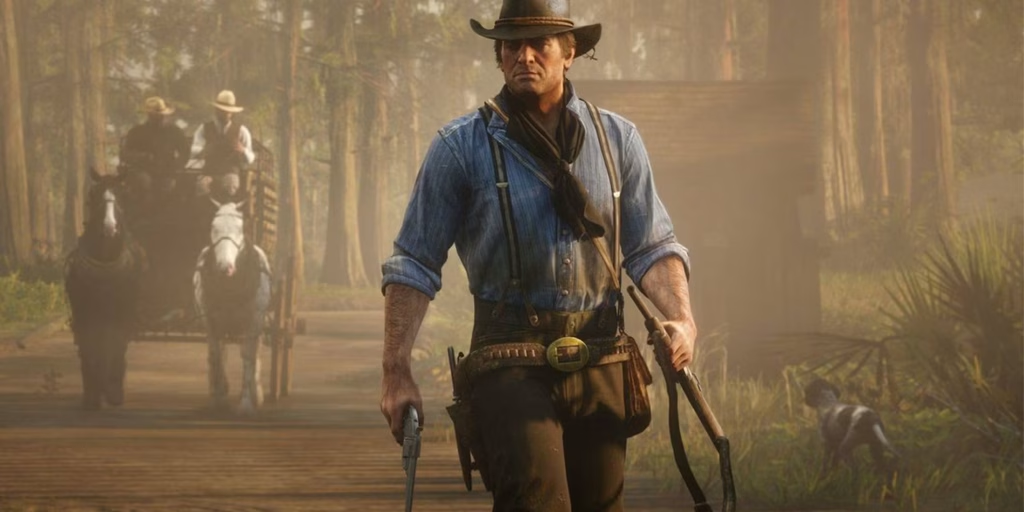
“Nothing means more to me than this gang. I would kill for it. I would happily die for it. I wish things were different. But it weren’t us who changed.”
Let me be honest with you about something. When Red Dead Redemption 2 came out in 2018, I was not particularly excited about Arthur Morgan. Nobody was. We all wanted John Marston — the grizzled, cool, beloved protagonist of the original Red Dead Redemption. John Marston was our guy. We knew him. We trusted him. He was the Western archetype we had already invested in, and frankly, we resented being handed this stranger instead.
Arthur Morgan? Who even was this guy? Some big, vaguely threatening bloke with a journal and a scowl? Great, thanks Rockstar. Really appreciated. And then, over the course of roughly sixty hours of gameplay, Rockstar Games did something that very few storytelling mediums have ever managed to do with the same level of effectiveness — they made us fall completely, devastatingly in love with someone we were predisposed to distrust. And then they killed him. The nerve of it, honestly.
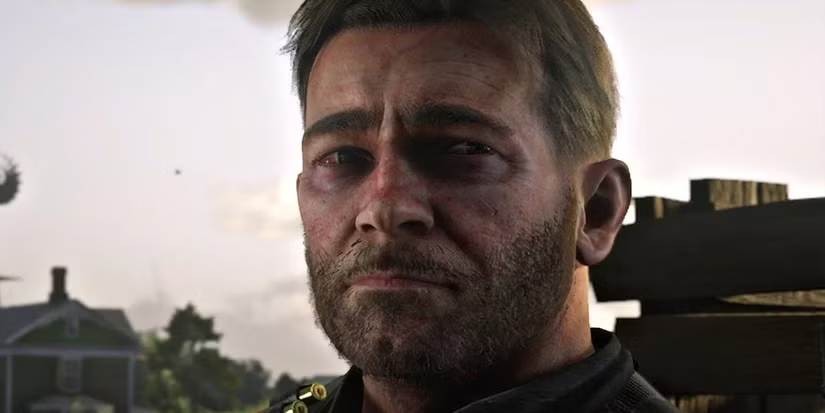
Let’s start at the beginning. Dutch van der Linde found Arthur on the streets at fourteen years old — a feral, angry orphan with nothing to his name and nowhere to go. His mother was dead. His father was a criminal who Arthur watched die, and not, as Arthur himself would later admit with characteristic bluntness, “soon enough.” There was no foundation underneath him. No structure, no guidance, no one who gave a single damn. Dutch gave him all of that. Dutch gave him a purpose, a family, an identity, and a philosophy. And Arthur — being fourteen and having no frame of reference for better options — took all of it and made it his entire world. This matters enormously, because it explains the central paradox of Arthur Morgan as a character: he is a deeply moral man who has spent his entire adult life doing deeply immoral things, and the reason the cognitive dissonance never destroyed him sooner is that Dutch van der Linde told him it was okay. Dutch had a justification for everything. The robbery was for the gang. The murder was for survival. The chaos was resistance against corrupt systems. And Arthur, the boy who had nothing and was given everything by this man, believed him. For twenty years, he believed him.
The Guy Who Keeps The Whole Thing Running
Here is what nobody tells you about Arthur Morgan before you start playing: he is essentially a middle manager. I know, I know. Bear with me on this one. Dutch is the visionary — the big ideas, the speeches, the sweeping philosophy about freedom and the American frontier. John is the complicated soul with a family pulling him in the opposite direction. Hosea is the wise counsel. Micah is the disaster waiting in human form. And Arthur? Arthur is the one who actually does everything. Someone needs to go collect a debt? Arthur. Someone needs to rescue a gang member from prison? Arthur. Someone needs to infiltrate a criminal compound, rob a train, shoot their way out of a bank heist, jump on a moving wagon, save the camp from an O’Driscoll ambush, or talk down a situation before it goes completely sideways? Arthur Morgan. Every single time. He is the van der Linde gang’s entire operational department, and like most people in that position, he does the work without the credit and carries the consequences without the sympathy. Dutch gets the speeches. Arthur gets the scars. That is the deal, and Arthur accepted it so thoroughly and so long ago that he barely notices it anymore. What he has, instead of recognition, is a journal.

The Journal
Let’s talk about the journal, because if you skipped past it during your playthrough, you robbed yourself. Arthur Morgan keeps a written and illustrated journal of his thoughts, observations, sketches of animals, portraits of people he meets, and reflections on everything from the beauty of a landscape to the specific moral weight of things he has done. The man can draw. The man writes with a quiet, gruff eloquence that suggests someone who reads a great deal more than he lets on. He sketches eagles and fish and mountain ranges with genuine affection. And then, in the same journal, he writes things like: “I am afraid of what I am and what I have done.” The journal is the emotional core of RDR2 that most players interact with only casually, and it contains some of the most honest and heartbreaking self-examination in the game. Arthur does not perform his conscience for other people. He does not make speeches about who he is or long monologues about his guilt. He writes it down privately and then goes out and does whatever needs doing anyway. This is a man who is fully, painfully self-aware and has decided that the awareness changes nothing — because the gang needs him, and Dutch needs him, and that is what his life is. Until it isn’t.
The TB Diagnosis and Everything It Changes
In Chapter 2 — which you may have blinked and missed — Arthur beats a debt out of a sick farmer named Thomas Downes. Downes, who is clearly dying of tuberculosis, coughs blood directly into Arthur’s face. The game does not stop to underline this. There is no dramatic music. Arthur wipes his face and moves on. Rockstar then spends four chapters — four entire chapters — building your attachment to this man while the disease quietly takes root in the background. By the time Arthur collapses in Saint Denis in Chapter 5 and is dragged to a doctor’s surgery, you are so invested in him that the diagnosis lands like a physical blow.

Tuberculosis. In 1899. No cure. The doctor tells him it is a progressive disease and literally cannot finish the sentence. He stops himself. Arthur responds with sarcasm — because of course he does — pays whatever the consultation costs, and walks out. He sits by the river. He writes in the journal. What makes this moment so extraordinary is that the game does not turn Arthur into a weeping, despairing figure after the diagnosis. It does the opposite. It focuses him. He knows now, in exact terms, what he has left. And what he decides to do with it is where the character transcends from “compelling protagonist” into something genuinely rare in any medium. He decides to try and be better. Not dramatically. Not with a grand gesture. Just — try to be better. Help people where he can. Fix what he can still fix. Tell John to take his family and leave while there is still a life to leave for. The man is dying of consumption in 1899 and he is out here making sure other people’s futures are intact before his runs out.
I am not crying. You are crying. Moving on.
Dutch van der Linde and the Heartbreak of Misplaced Loyalty

To understand Arthur Morgan’s tragedy, you have to understand what Dutch van der Linde means to him. And this is where it gets genuinely painful. Dutch is not simply Arthur’s boss. Dutch is, functionally, his father. The man who took a fourteen-year-old street kid with nothing and made him into something. Dutch van der Linde taught Arthur to read. He gave him a philosophy. He gave him a family. He gave Arthur Morgan the only life Arthur Morgan has ever known. And Arthur loved him for it completely, unquestioningly, for over twenty years. The genius of RDR2 is that it does not make Dutch into a cartoon villain. He is not secretly evil from the start. What he is, is a man whose grand vision — of freedom, of resistance, of a gang that operates by a moral code in a corrupt world — has slowly been corrupted by paranoia, ego, and the refusal to accept that the world he is fighting against has already won. Dutch van der Linde in Chapter 6 is not the same man who took in Arthur at fourteen. Something broke in him, somewhere between Blackwater and Guarma, and what is left is a shadow of the idealism that made Arthur believe in him.

But Arthur cannot let go. Not fully. Not until the very end. Because — and here is the thing that makes Arthur’s arc so devastating — walking away from Dutch means accepting that the last twenty years of his life were built on something that collapsed. It means accepting that the family he chose is not what he thought it was. It means accepting that the version of Dutch van der Linde who shaped him has been gone for years, and that Arthur has been loyal to a ghost. “I gave you all I had.” Four words. Delivered to Dutch at the end. And in those four words is twenty years of devotion, sacrifice, violence, loyalty and finally — finally — the grief of a man who has understood something too late. There is no better written line in the game. There may not be a better written line in gaming, full stop.
The Honor System and What It Actually Means
RDR2 has an honor system. High honor Arthur is generous, compassionate, and increasingly focused on doing right by people. Low honor Arthur is brutal, selfish, and about as pleasant as Micah Bell on a good day. Most players, on their first run, gravitate toward high honor. Not because the game forces you to — it does not — but because Arthur Morgan, the character, pulls you there. The journal changes with the honor rating. Arthur’s reflections on himself become more hopeful or more despairing depending on who you choose to be. The game is quietly asking you, through the mechanism of play, to decide: who is Arthur Morgan, really? The violence or the decency underneath it? What makes this more than just a morality meter is that by Chapter 6, the honor choice carries an entirely different weight. Arthur is dying. The question is no longer “what kind of outlaw are you?” It is “what kind of man will you be with the time you have left?“

High honor Arthur crawls to a clifftop to watch the sunrise. He dies watching the light come up over the mountains, face turned toward the sky. It is quiet and beautiful and completely, utterly annihilating. Low honor Arthur gets stabbed by Micah in the dark. Rockstar is not subtle about what they are communicating here, and you know what? Good. Arthur Morgan earned the sunrise. The man beat a dying farmer for debt money, yes, and he did a hundred terrible things in service of a gang that did not deserve him — but he spent his last chapter trying, quietly and without fanfare, to make things right where he still could. He expelled Strauss from the camp. He helped Rains Fall. He pushed John toward the exit at every possible opportunity. He chose John over the money.

The sunrise is his. Nobody else’s. And if you watched it and felt nothing — well. I genuinely worry about you.
“I Tried. In the End. I Did.”
These are Arthur Morgan’s actual last words, in the high honor ending. Not a war cry. Not a dramatic speech. Not a villain’s monologue or a hero’s proclamation. Let that sit for a second. This is a man who knows, with complete clarity, that he was not a good man by any reasonable definition of the phrase. He killed people. He robbed people. He terrorized people for money and for Dutch’s vision of a world that was never going to materialize. He is not deluding himself about any of it. But he is also — and this is where Rockstar’s writing does something genuinely profound — claiming something small and true: he tried. At the end. He did. Not at the beginning. Not for twenty years. But in the time he had left, when the tuberculosis gave him a hard deadline and the illusions about Dutch finally cracked — he tried. He chose better, repeatedly, when it was harder and more costly to choose better than to do what came naturally. That is not a redemption arc in the Hollywood sense — no grand absolution, no dramatic moment of transformation. It is something quieter and, I would argue, more honest. It is a man acknowledging that he was both things: the violence and the decency, the outlaw and the person who wanted to be something more than an outlaw. And that at the end, one of those things won, just barely, just enough.
You could spend a long time thinking about whether that is enough. Whether a life of violence and harm can be offset by a final act of chosen decency. Whether Arthur Morgan deserved the sunrise. I think he did. I think you probably do too.
Why Arthur Morgan Is One of The Greatest Video Game Characters Ever Written

We have had great video game protagonists before. We have had compelling ones, sympathetic ones, morally complex ones. But Arthur Morgan sits in a category that is genuinely small — characters who feel not like protagonists but like people. People who contain contradictions. Who are neither entirely redeemable nor entirely lost. Who have history and weight and a specific, irreducible personality that exists independent of the plot mechanics around them. He is funny. Not in a written-for-laughs way but in the genuine, dry, observational way of someone who has seen enough of the world to find most of it absurd. His delivery when Dutch announces yet another plan to escape to Tahiti is a masterclass in barely-contained disbelief. His interactions with Uncle are practically a comedy double act. His sarcasm in the face of mortal danger is consistent and deeply, specifically his. He is kind. Not softly, not easily — but consistently, when it matters. He helps strangers when the game gives him the choice. He advocates for people nobody else advocates for. He looks after Jack Marston with a quiet protectiveness that he would never articulate as affection. He is kind the way people are kind when kindness does not come naturally but they choose it anyway.
He is devastatingly human. He makes wrong choices and right choices and choices he cannot take back and choices he is clearly proud of. He loves Dutch past the point where that love serves him. He grieves Sean in the same moment he has to keep moving. He writes about the landscape in his journal with a genuine tenderness that has nothing to do with the outlaw he is supposed to be. And then he dies. He dies young, in the mountains, with the sun coming up — and the person he spent his last chapter giving everything to goes on to have the life Arthur could never have. John Marston gets the ranch. Arthur Morgan gets the sunrise. And honestly? Given what he did with the time he had, and who he chose to be when the end came — I think Arthur got the better deal.
THE STORY
Chapter 1: Colter
Listen… Listen to me all of you, for a moment. Now, we’ve had.. well, a bad couple of days. I loved Davey… Jenny… Sean, Mac, they may be okay, we don’t know. But we lost some folks. Now, if I could… throw myself in the ground in their stead… I’d do it… gladly. But…we’re gonna ride out and we are gonna find some food. Everybody, we’re safe now. There ain’t nobody following us through a storm like this one… and by the time they get here… well, we’re gonna be… we’re gonna be long gone. We’ve been through worse than this before. Mr. Pearson, Miss Grimshaw, I need you to turn this place into a camp. We may be here for a few days. Now all of you… all of you. Get yourselves warm. Stay strong. Stay with me. We ain’t done yet!
– Dutch van der Linde
By 1899, the age of outlaws and gunslingers was at an end. America was becoming the land of laws…Even the west had mostly been tamed. A few gangs still roamed but they were being hunted down and destroyed.
May 1899. We start the game with a cutscene showing a slow moving caravan trudging through a snowy hellscape. Hosea Matthews and Dutch van der Linde are discussing a failed ferry heist which turned into a shootout between the law and the van der Linde gang and we understand that two of their gang members were shot – Jenny Kirk who was already dead and Davey Callendar who was dying. Some of the members were scouting for a place to rest their heads at and for the first time during the game, we hear the name Arthur Morgan, who Dutch says is scouting the land ahead. Arthur informs them that he found a mining village called Colter which is abandoned but has shelter for them to rest at. As the gang moves into Colter and Davey is moved on to one of the beds, we hear Abigail Roberts mention to the gang that Davey is dead.

Hosea speaks to Dutch about the gang’s precarious situation and informs him and Arthur that they are out of supplies. Dutch and Arthur leave, into the snowstorm to try and find John and Micah who were out scouting. They stumble on to Micah, who informs them about a cabin which is occupied and might have the supplies. Dutch goes to speak to the residents of the cabin, while Micah and Arthur take up position nearby in case the conversation goes sideways. The residents of the cabin come out and we see Dutch talking to one of the people while others come out. Meanwhile Micah notices a dead body on a cart in the snow and alerts Arthur. As one of the residents recognizes Dutch, Arthur begins to shoot to protect Dutch and the ensuing shootout results in all the residents of the cabin dying. It is later discovered these are members of a rival gang – the O’Driscoll’s whose leader is a sworn enemy of the Dutch. Once the O’Driscoll’s are killed, Dutch asks Arthur and Micah to raid the house for supplies – some of which Arthur eats and we learn how to keep his core full by consuming different items which impacts his health and stamina. Arthur then goes to check the barn where a surviving O’Driscoll ambushes him. After beating him, Arthur interrogates him and finds out that the O’Driscoll gang is planning a train heist in the mountains. He then has the choice to either kill him or let him go – the honor system is introduced by this event. We also learn to tame a horse – our primary mode of transportation in the game.

Meanwhile there is commotion in the house and we see Micah fighting with a young woman – Sadie Adler is introduced. The house catches fire and Dutch calms Sadie down and they all leave back for their camp in Colter. Sadie informs them that the dead body in the cart was her husband and they were attacked by the O’Driscoll’s in their home. As they move back to Colter, the first Chapter officially starts. Now the Colter chapter of RDR2 is much more restricted in terms of player freedom than the later chapters as it is technically a training mission which gets players familiar with the new features of the game. We are introduced to hunting (The Aftermath of Genesis) – tracking game with dead eye etc. – as we are sent by Pearson, to get meat for the camp’s supplies and we go with Charles. Another mission (Enter, Pursued by a Memory) has Abigail request Arthur and Javier to find John who never came back from scouting, who we find in the mountains fending off wolves. The badly mauled John Marston is brought back by Arthur and Javier. During these two missions we learn a bit more about the Blackwater Ferry job and the gang’s history.
The next mission in Colter we can undertake involves us being led by Dutch into an attack on the O’Driscoll camp to learn more about a train heist robbery which the gang member in the barn at Adler Ranch told Dutch and Arthur about (Old Friends). This mission teaches players the weapons wheel and the utilization of dead-eye during combat. Colm O’Driscoll, the leader of the enemy gang is seen at the start of the mission but has left the camp with some of his henchmen during the attack. We acquire plans and dynamite during the attack on the O’Driscoll camp. As we return, we capture an O’Driscoll who was away during the attack and we learn his name – Kieran Duffey – who would eventually become a member of the van der Linde gang.
The last mission of Colter involves the train robbery (“Who the Hell is Leviticus Cornwall?”) – which Dutch undertakes claiming the gang needs money to escape. The heist is on a private car owned by Leviticus Cornwall, another antagonist who will play a major role in the plot as we move forward in the game. Bill tries to blow the tracks to derail the train but the explosives don’t go off, leading Arthur, Lenny and Javier to jump on top of the train to stop it. Javier falls off the train but Lenny and Arthur manage to kill the guards and stop the train. During the shootout that ensues, several guards are killed by Arthur and Lenny and then the rest of the van der Linde gang – Javier, Micah, Bill, Charles and Dutch join in. They blow open the doors to a private car on the train and rob it – we are introduced to train heists (a way of earning money) in this mission. The gang acquires rail bonds to sell from the heist. Arthur can either kill or let go, the few survivors and then make his way back to the camp.
During Colter, we are also introduced to Arthur’s journal where he writes, draws and talks about his feelings, the things he sees and which is a dynamic log book of the story as it progresses. It also changes based on the honor rating and the things Arthur sees or does. Once the robbery is complete, we see the snow thawing and the gang moves towards another location towards the East (Eastward Bound), Horseshoe Overlook, which Hosea knows about and is near a livestock town – Valentine. During the journey, we are also introduced to different herbs which we can use to make elixirs and draughts which have positive effects on Arthur’s health and stamina.

Chapter 2: Horseshoe Overlook
“We went and made our choice a long time ago, so, I guess we gotta pay for our sins.”
– Arthur Morgan
One of my favorite chapters in RDR 2. This is the chapter that opens up the world for Arthur Morgan – hunting, fishing, robberies, camp upgrades, companion activities and loan-collection. We are also introduced to the town of Valentine which truly brings the world of the American West to life. It is also close to a location called Emerald Ranch – which is basically a livestock and grazing ranch, where we find ourselves a fence – a fence is a location where we can sell valuables, sell stolen stage-coaches and buy certain gear. Similar fences are located in Rhodes and in St. Denis. The chapter also sows the seeds of Arthur’s eventual demise but we will get to that later.


The van der Linde gang settles into a nice hill top camp called Horseshoe Overlook. It is close to the town of Valentine and in the middle of beautiful lands called the Heartlands – lands stolen by settlers from the Native Americans as Hosea tells us during the journey. As we start the chapter, after Dutch’s speech to the gang members – that everyone has to do their share and that the gang needs money before they can afford some land to settle on out West – we wake up to Hosea providing us a warm cup of coffee and informing us about what everyone’s been upto – Reverend Swanson found some activity at Flatneck Station. Charles, Bill and Javier are in the saloon in Valentine and Strauss has gone out loan-sharking. Micah and Lenny haven’t returned from scouting. As we start, we check out Reverend Swanson first (Who is Not without Sin) – he has found a card game at Flatneck Station which can be used to make some extra money. The drunk Swanson sneaks away and gets into trouble from which Arthur saves him (from being beaten up and then from an oncoming train). After we’ve returned Reverend back to the camp, we next see Uncle dozing and after waking up, he mentions some leads in Valentine, which we proceed to investigate with Mary-Beth, Tilly and Karen joining Arthur and Uncle (Polite Society, Valentine Style). In Valentine, we save Karen and Tilly from trouble and also eliminate a threat, in the form of a man who recognizes Arthur and the others from Blackwater. The next mission, I played was capturing a criminal called Benedict Albright (Good, Honest, Snake Oil) which introduces us to the option of Bounty Hunting.


We next meet Bill, Javier and Charles in Smithfield’s Saloon in Valentine (Americans at Rest) in which Bill starts a fight and Arthur beats up a giant of a man and we also meet up with Josiah Trelawney who mentions he has a lead on Sean’s whereabouts. Meanwhile all this time, Kieran, who we captured in Colter, has been tied to a tree. Approaching him triggers the next mission (Paying A Social Call), where he mentions Colm O’Driscoll and the others in his gang are hiding in Six Point Cabin, near Valentine. Arthur, Bill, John and Kieran attack the cabin and kill the gang members but Colm is nowhere to be found. Arthur is also saved by Kieran during the attack and he allows Kieran to stay with the gang (even though he mentions that he won’t be fully trusted). Next, after Hosea spotted a huge bear up by the Dakota River, he and Arthur ride out and track it (Exit Pursued by a Bruised Ego). This mission teaches about legendary animals to hunt and turn their pelts into valuable clothing and satchels and also about setting up camp in the wilderness and crafting bullets, food etc. Lenny returns and informs Dutch that Micah has been captured in a town called Strawberry and his awaiting being hanged. Dutch convinces a reluctant Arthur to save Micah from the hangman’s noose. But before he goes to Strawberry, Arthur takes Lenny drinking at Smithfield’s Saloon in Valentine (A Quiet Time) – a memorable and entertaining albeit filler mission. Arthur, next visits the town of Strawberry and locates Micah in the prison cell under the Strawberry Sheriff’s Office. He breaks Micah out and an ensuing shootout leads to several dead in the town (Blessed are the Meek?). After Arthur returns, he meets with Strauss, who asks him to collect loans from several unfortunate people, Strauss has been lending to (Money Lending and Other Sins I & II) – he starts with a ranch hand Chick Matthews (Emerald Ranch), Polish smallholder farmer Mr. Wróbel (near Horseshoe Overlook), and ranch maid Lilly Millet (Emerald Ranch) – how Strauss got all the way to those locations is beyond me as he doesn’t even ride a horse.


The final debtor in Valentine, is a man named Thomas Downes (Money Lending and Other Sins III). The mission to collect debts from Thomas Downes, is a critical part of Arthur’s redemption arc. As Arthur beats Thomas Downes at his ranch, the sick and coughing Thomas, coughs up blood into Arthur’s mouth. For someone who is playing the game for the first time, this event seems unimportant but for veteran gamers, we all know where it leads. We also meet Downes’s wife and son for the first time. After Arthur returns the debt back to the camp, he next goes to meet Hosea at Emerald Ranch. Here he meets Seamus (the owner of the Emerald Ranch fence) He steals a stage coach from Seamus’s cousin at Carmody Dell along with Hosea (The Spines of America). After we return back to camp with Hosea, we decide to go rescue Sean from bounty hunters with the help of Charles, Javier and Trelawney (The First Shall be Last). This mission brings Sean (an entertaining Irish lad who has several memorable moments in the game) back to the camp. It also triggers a camp party full of drinking and entertaining songs and a dance with the beautiful Mary-Beth, for Arthur. Sean also manages to score with Karen.


After Sean’s party, the next day Arthur takes Jack fishing as a favor to Abigail (A Fisher of Men) and because John still treats Jack as not his son. This mission opens up fishing as an activity for Arthur – we can also purchase bait at the general store and also provide fish to Pearson for the camp’s provisions or sell the fish to the butcher for money. During the fishing trip, Arthur is confronted by two Pinkerton agents, including Agent Milton who inform him that they killed Davey Callander and they want Dutch. In return for Dutch’s capture, Arthur and the others will be allowed to go free. Arthur refuses and informs Dutch on his return. Later, Arthur meets with John who triggers the train robbery, Mary-Beth found out about during the mission “Polite Society, Valentine Style“. This leads to us preparing for stopping the train with an oil wagon on the track (Pouring Forth Oil – I, II, III & IV) – stealing an oil wagon, John collecting supplies, bringing the wagon onto the track, then robbing the passengers and escaping from the law with John, Charles and Sean. Once we are back in camp we receive a letter from Arthur’s long-lost love Mary Linton. She is in Valentine and wants to meet Arthur (We Loved Once and True I, II & III) and as with most women in real life, she wants something from Arthur – starting with rescuing her brother Jamie who has been led astray by a cult called the Chelonian Order. Once we return Jamie back to Mary at the Valentine train station, there will be a few sweet words said and Mary will leave. This is an optional mission and doesn’t really impact Arthur’s story from a purely gaming view point but it adds more weight to his redemption arc.


Arthur next goes to Strawberry to a cave hideout, where Micah is camping as he doesn’t want to return to Dutch without something in return (being the cowardly snake he is). Arthur meets Micah who tells him about a bank coach which they can rob (An American Pastoral Scene). However, after robbing the coach, they are ambushed by the O’Driscoll’s who Arthur and Micah make short work of. It is a fun mission but it means Micah is seen hanging around the camp all the time which is a major negative so I usually play it at the end. Arthur next gets the message in camp, that John has found something in Valentine and Arthur goes to meet him near the sheep auction yard (The Sheep and the Goats). The mission starts off boring but we unlock a Rolling Block Rifle – a sniper rifle at the gun store. We steal some sheep and then bring it to Valentine to be auctioned – however, the auctioneer, knows these are stolen sheep and insists on a 18% kickback. An annoyed Arthur and John go to the small saloon in Valentine, where Dutch is arguing with Strauss. Dutch sends John and Strauss to talk to the auctioneers but they are captured by Leviticus Cornwall and his hired security. Cornwall demands Dutch’s surrender – Arthur and Dutch go out but Cornwall has gone, leaving his security detail to finish off Dutch. Arthur suddenly pulls out his gun and starts shooting and kills the men holding John and Strauss and a shootout ensues with more men pouring in from all directions. Strauss gets shot and Dutch and John push a cart with him in it, through the main street of Valentine while Arthur gets to do what he does best – shoot and kill. Everyone escapes with Arthur covering the retreat. When Arthur loses the law and returns to camp, the camp is being packed up. This is the end of the gang’s stay in Horseshoe Overlook.


Arthur enters Dutch’s tent where Dutch and Hosea are arguing, as Hosea is angry that the gang blew their cover and have to move again. Dutch asks Arthur to find a new location for the gang – he asks them to check out Micah’s suggestion about Dewbury Creek (A Strange Kindness). Arthur takes Charles along with him to scout the new location. They discover a small camp and a dead body while also realizing the site is unprotected and dangerous during rains. While checking the camp, they discover a woman and her kids hiding. Apparently their camp was attacked and her husband was kidnapped by the bandits. Though Arthur is reluctant, Charles convinces him to track the husband down and rescue him. Tracking the man, they reach a location called Clemens Point, which Charles says, is a much secure location compared to Dewbury Creek. They find the man who shouts that they are in a trap and suddenly the bandits attack – Arthur and Charles kill the men and Arthur takes the man back to his family. He tells Charles to meet up with the gang and re-direct them to Clemens Point instead as the new camp site. Arthur takes the man back and is rewarded by the man, with a gold bar for saving his life (Yay! $500). This mission concludes the chapter.


Chapter 3: Clemens Point
“You Don’t Get To Live A Bad Life And Have Good Things Happen To You.”
– Arthur Morgan


The gang’s relocation to Clemens Point — a camp set on the shores of Flat Iron Lake in Lemoyne — marks a shift in the game’s tone and momentum. The events of Chapter 2 made it clear that Arthur and the gang went too far in the Valentine area. Targeting Leviticus Cornwall’s business repeatedly prompted the man to act, leading to a violent confrontation in Valentine and the gang being forced to leave Horseshoe Overlook. The Pinkerton Detective Agency, already investigating the botched Blackwater robbery, had also managed to locate the camp, helping Dutch make the decision to relocate. Compared to the fugitive desperation of Colter or the relative calm of Horseshoe Overlook, Clemens Point is where the gang begins to operate with renewed ambition — and where that ambition begins its slow, catastrophic collapse.
The chapter opens with Dutch, Hosea and Arthur going fishing — a deceptively quiet mission that is one of the game’s most character-rich sequences. As the three of them row out onto the water, Dutch talks about his vision for the gang’s future and instructs the others to keep a low profile in the nearby town of Rhodes. After the deputization that follows in Rhodes, the gang is constrained from using weapons anywhere in the town — a detail that neatly mirrors how trapped the gang is becoming in its own schemes. The fishing scene itself is not mandatory. The player can refuse and end the mission early. But doing so means missing one of the few moments in the game where Dutch, Hosea and Arthur simply talk — three men who built something together, still capable of an afternoon of quiet before everything unravels. Most players who’ve been through the game more than once make sure they stay for the fishing.


Rhodes is a rundown town that has lost much of its antebellum charm, sitting in the grip of a feud between two old local families — the Grays and the Braithwaites. Dutch and Hosea see an opportunity in this dispute to exploit it for the gang’s benefit. The scheme they devise involves working for both families simultaneously — playing each against the other, stealing from one and selling to the other, while pocketing money on both sides. Arthur is deployed as the instrument of nearly all of it. He rides for the Grays, he rides for the Braithwaites, and he does both while wearing the face of a loyal hired hand. The chapter gives the player a sustained portrait of the gang operating at the peak of its craft — and simultaneously demonstrates exactly why that craft was never going to be enough to save them.
The first major operation involves the Braithwaite moonshine. Arthur, Dutch and Bill are temporarily deputized by Sheriff Gray to help shut down a moonshine distillery operated by the Braithwaites. The mission has a genuine stealth component — the first in the chapter — as the group moves through the atmospheric Lemoyne swamp to knock out the moonshiners quietly before destroying the operation. The distillery is blown up, the Grays are satisfied, and the gang acquires a wagon of Braithwaite moonshine in the process. What follows is one of Chapter 3’s darkly comic highlights: Hosea’s scheme to sell that same stolen moonshine back to the Braithwaites. Arthur and Hosea ride up to Braithwaite Manor under the pretense of commerce, and Arthur ends up behind the bar of a local saloon pouring drinks while Lemoyne Raiders come crashing through the door. The gang’s belief throughout this chapter is that they are duping idiots — when in reality, they are the ones behaving like buffoons.


Running parallel to the Braithwaite and Gray scheming is a more personal thread. Beau Gray asks Arthur to deliver a letter to Penelope Braithwaite at Braithwaite Manor — and later, Arthur escorts Penelope and other protestors through Rhodes as they participate in a women’s suffrage rally. These missions sit outside the main loop of robbery and manipulation. Beau and Penelope are genuinely in love, genuinely in danger, and they are asking Arthur — a man whose entire professional life is organized around exploitation — to help them. He does. Without much complaint. The Beau and Penelope thread is one of the quieter illustrations of who Arthur actually is beneath the work he does for Dutch.
Lenny has intelligence on a group of Lemoyne Raiders — Civil War veterans dealing in stolen weapons — and asks Arthur to help him raid their Shady Belle hideout to take them. The mission itself is a significant one beyond the weapons haul: it is Arthur and Lenny operating together, and the best part of the mission is the relationship between Arthur and Lenny — Arthur assuming the role of outlaw mentor, which gives him depth beyond the gruff interactions he has with his peers. Lenny is one of the gang’s younger members, educated and thoughtful, and Arthur’s respect for him is visible in a way it isn’t always with the others. The Shady Belle location, noted and cleared here, will matter again before the chapter ends.


Uncle meanwhile hears of a Cornwall payroll wagon that will be lightly guarded at a certain point in its journey and recruits Arthur, Charles and Bill to take it. The heist goes smoothly enough until the gang holes up in a shed with the stolen goods and is eventually found. By the time they are discovered, the sun has gone down and the light is simply stunning. The battle that follows in the shack and the surrounding woods produces some of the chapter’s best combat. It is one of several moments in Chapter 3 where Rockstar’s craft — the way the world looks at a particular hour, in a particular season — elevates what is structurally a fairly routine robbery mission into something the player remembers.
Then there is the Valentine bank job. Bill, Karen and Lenny want to rob the bank in Valentine and bring Arthur in. The plan is roughly as follows: Karen pretends to be drunk or lost, the rest of them rush in. It is not an elaborate scheme. But it works well enough, with Karen creating the distraction while Arthur forces his way into the vault. The player has a choice between cracking the safes quietly or blowing them — the latter is faster and considerably louder, drawing law enforcement faster. The bank is robbed, the gang escapes, and the money goes into the camp’s coffers. It is the most straightforward job of the chapter and the last one that goes cleanly.


Because underneath all of this activity — the moonshine, the payroll, the horses, the bank, the love letters — the Grays and Braithwaites are not the passive marks Dutch and Hosea have taken them for. Both families understand they are being manipulated. Both are waiting for the right moment to respond. To retaliate against the Braithwaites, Tavish Gray asks Arthur, John and Javier to steal prized thoroughbred horses from Braithwaite Manor, claiming they will fetch $5,000. The horses are stolen. The money never materializes the way it was promised. The Grays and Braithwaites both feel the sting of the gang’s interference, and both begin moving toward retaliation.


The Grays move first. Arthur, Micah, Bill and Sean ride to Rhodes for what is presented as a meeting with the Gray family to discuss a security arrangement. It is a trap. In the mission “A Short Walk in a Pretty Town,” the Grays spring the ambush — lawmen and hired guns emerge from the buildings around them — and Sean MacGuire is shot dead in the street. The death is fast and undignified. Sean had been a presence since Chapter 1, one of the first gang members rescued and returned to the fold, and his energy — loud, reckless, genuinely warm — had been a consistent thread through the camp scenes. We get a glimpse of Arthur’s softer side when he mourns Sean’s death. With Arthur always seeming so combative with his companions, it is easy to forget that his agitation comes from the place a brother’s might.
The Braithwaites deliver their answer separately. They kidnap Jack Marston. Dutch, having learned this, decides it is time to ride out to Braithwaite Manor in full force. At the manor, things escalate quickly, and Arthur learns from the dying Catherine Braithwaite that Jack has been taken by Angelo Bronte — a crime boss in Saint Denis. The manor burns. Catherine Braithwaite dies in its ruins. The gang has obliterated both families and gained nothing except a new, more dangerous problem: their leverage is gone, Jack is in the hands of someone far more powerful than either of these feuding plantation families, and the Pinkertons have used the chaos to locate Clemens Point.


In the final mission of Chapter 3, “The Battle of Shady Belle,” with both families destroyed and the Pinkerton agents closing in on the Clemens Point camp, the gang needs to move fast. Arthur suggests the old plantation at Shady Belle — the same location he and Lenny scouted earlier in the chapter. Dutch sends Arthur and John ahead to clear the remaining Lemoyne Raiders from the building before the gang relocates. Chapter 3 ends with the gang worse off in almost every measurable way than when they arrived. Sean is dead. Jack is missing. Both the Grays and Braithwaites have been destroyed without generating the windfall Dutch promised. The Pinkertons know where they are. And they are now camped in a swamp mansion on the outskirts of the most civilized city in the region — a city that will swallow the van der Linde gang whole before Chapter 4 is finished.
Chapter 4: Shady Belle
“We’re thieves, in a world that don’t want us no more”
– Arthur Morgan

The gang has headed to Saint Denis in pursuit of Jack, and is now hiding in a rundown old manor house called Shady Belle, deep in the swamps outside the city. Dutch is desperately searching for an escape plan, while Hosea is hunting a serious score. After the wreckage of Chapter 3 — Sean dead, both families destroyed, Jack missing and the Pinkertons at the door — Shady Belle feels less like a camp and more like a holding position. The gang is waiting for Dutch to produce the plan that gets them out. He produces several. None of them work the way he says they will. Saint Denis itself arrives in Chapter 4 like a world the player hasn’t seen before. It is a city that has begun to progress forward with technology — brick roads, lamp posts, a working trolley system. It is modeled loosely on New Orleans: dense, layered, beautiful and indifferent to the people inside it. For the player, the first arrival is visually stunning. For Arthur and Dutch, Saint Denis is not a technical marvel to fawn over. It is the death of the only lifestyle they know. Everything the gang represents — freedom, movement, violence as a way of life — has no place here. The city is the future arriving ahead of schedule, and it has no use for outlaws.


The chapter opens with Dutch and Arthur riding into Saint Denis to gather intelligence on Angelo Bronte — the crime boss now holding Jack. Arthur and Dutch split up in search of information about Bronte. Arthur ends up navigating the city’s streets, asking questions in bars, chasing a pickpocket through the alleys, and bribing street children for information — a sequence that efficiently introduces the player to Saint Denis as an environment while establishing that Bronte is not a man who is easily approached. He is powerful, connected and theatrical, and he will need to be handled carefully. The chapter opens with Dutch and Arthur riding into Saint Denis to gather intelligence on Angelo Bronte — the crime boss now holding Jack. Arthur and Dutch split up in search of information about Bronte. Arthur ends up navigating the city’s streets, asking questions in bars, chasing a pickpocket through the alleys, and bribing street children for information — a sequence that efficiently introduces the player to Saint Denis as an environment while establishing that Bronte is not a man who is easily approached. He is powerful, connected and theatrical, and he will need to be handled carefully.


Dutch, Hosea, Arthur and Bill attend Mayor Lemieux’s garden party at the invitation of Bronte — a mission that requires the gang to dress in tuxedos and move through high society entirely without weapons. It is one of the most tonally distinct missions in the game. Arthur, a man who solves most problems with a rifle, must navigate a formal garden party by pouring drinks for women, complimenting hats, and saving a guest from a drunken altercation. Bronte greets Dutch and Arthur on the balcony and proceeds to point out and mock the party guests around them — including Mayor Henri Lemieux, and a father-and-son pair named Rains Fall and Eagle Flies, who are attempting to deliver a letter to the mayor. Bronte is performing his power for them, showing Dutch the world he inhabits and the world Dutch can never enter. Dutch smiles through it. The animosity is visible underneath. While at the party, Arthur tails the mayor’s butler Pierre through the mansion to the mayor’s private office, retrieves documents the mayor was meant to sign, and the gang leaves with two targets in mind: a high-stakes poker game on a riverboat, and the Saint Denis Bank. On the way home, Dutch tells Arthur they are “almost home” and just need one more score. The phrase will become a dark refrain. Dutch has been saying some version of “one more score” for the entire game.


The riverboat heist — “A Night of Debauchery” — requires Arthur to clean himself up first. Trelawny informs Arthur that he looks like “a dirt cowboy” and won’t pass on the riverboat. Arthur follows Trelawny to the tailor for a fine suit and to the barber before boarding the riverboat by stagecoach. The mission has Arthur mingling as a high-roller, playing cards and gathering intelligence before the job turns into the kind of shootout that ends most of the gang’s sophisticated plans. It is a microcosm of everything Dutch believes the gang can be — operating at the level of civilization, not beneath it — and it ends, as it always does, in gunfire. Meanwhile, the O’Driscoll gang — present since Chapter 1 as the recurring enemy faction — launches a direct attack on Shady Belle. Kieran Duffy, the former O’Driscoll who had become a trusted member of the van der Linde gang, is found dead — his decapitated body delivered to the camp on horseback as a message. The attack that follows is a full assault on the mansion, the gang defending from the balcony and the grounds while O’Driscoll forces come from multiple directions. The attack is eventually repelled, but Kieran’s death lands hard. He had earned his place in the gang through loyalty and through Arthur’s grudging advocacy. He is gone before most players have fully processed his arc.
The trolley station robbery — “Urban Pleasures” — is the moment Dutch’s arrangement with Bronte collapses completely. Acting on Bronte’s tip that the trolley station holds a large amount of cash, Dutch, Arthur and Lenny go in guns drawn. The safe yields almost nothing. Bronte had set them up. All of the city’s law enforcement converges on the station simultaneously. The three of them fight through the streets of Saint Denis, using a trolley car as mobile cover, and barely escape with their lives. The money is negligible — Arthur sarcastically suggests they split the fifteen dollars and not forget the twenty-five cents. Dutch, enraged, says Bronte tried to hand them to the police and announces there is still a bank in Saint Denis worth hitting. The plan accelerates rather than pauses. This is the pattern. Dutch knows a man in Lagras who can get them by boat into Bronte’s mansion from the swamp. They help the man with his traps in exchange for passage. The raid on Bronte’s mansion catches him off guard. They capture him. What follows is the chapter’s clearest turning point in Dutch’s characterization: Dutch drowns Bronte in the bayou and feeds his body to an alligator. There is no pretense of strategy in it. No argument that Bronte needed to be silenced for the gang’s safety. It is Dutch losing control of something he has always been able to contain — himself — and neither Arthur nor anyone else says a direct word about it. The silence around the act is more unsettling than any dialogue could be.


With Bronte dealt with, Dutch immediately redirects to the bank. The Saint Denis bank job — “Banking, The Old American Art” — is the chapter’s final mission and one of the most cinematically ambitious sequences in the game. The remaining gang members ride into Saint Denis for the heist, with only Sadie, Mary-Beth, Pearson, Swanson, Molly, Trelawny and Jack absent — Sean and Kieran having already died before the heist takes place. The job begins with apparent control. It ends almost immediately in catastrophe. The Pinkertons have the building surrounded. The safe yields money, but the escape route collapses. Dutch blows a hole in the wall with dynamite to get the gang to the rooftop. Lenny Summers is killed by Pinkerton gunmen during the escape across the rooftops. His death is the only gang-related death in the game to happen outside of a cutscene — the player is moving, following Lenny across the roof, and then he is simply gone, shot down in front of you with no ceremony. It is a devastating piece of game design: no music swell, no slowdown, no cutscene to frame the grief. Lenny dies in the chaos, and the player has to keep moving because the Pinkertons are still coming. Hosea Matthews is shot in the chest by Agent Milton in a cutscene earlier in the same mission — a public, deliberate execution that Arthur is forced to watch from a distance, unable to intervene. Two of the gang’s best people die in the same mission. The chapter that began with the gang’s most ambitious operations ends with its most devastating losses.


John Marston is captured alive by the Pinkertons during the chaos and later sent to Sisika Penitentiary. The remaining six — Dutch, Arthur, Micah, Bill, Javier and Charles — hide in an abandoned apartment until nightfall before making their way to the docks and boarding a boat bound for the Caribbean. The boat is sabotaged. It sinks in a storm. Arthur, Dutch, Bill, Micah and Javier wash up on an island that is not America. Chapter 4 is over. What Chapter 4 accomplishes narratively — across its fourteen missions — is the complete dismantling of every belief the gang held about its own competence and Dutch’s leadership. The gang walked into Saint Denis with Jack missing and walked out with Hosea dead, Lenny dead, Kieran dead, John imprisoned, and the survivors shipwrecked in the Caribbean. The city did exactly what Dutch refused to believe it would: it swallowed them whole.

Chapter 5: Guarma
“Arthur: You keep killing folk Dutch. Dutch: I’m just trying to make sure that some of us survive Arthur.”


Chapter 5 is the shortest in the game and the most divisive among players. It has no open world, no horse, no camp, none of the accumulated gear or bonds that the player has built across the previous four chapters. The gang is stripped down to survival conditions and dropped into a world that has nothing to do with the American frontier. For a game that has spent sixty-plus hours making the player feel rooted in a place, the sudden removal of all of that is jarring by design. Guarma disorients the player the same way it disorients Arthur. That is the point. The boat sank in the Caribbean and the survivors washed ashore on Guarma — a sugar cane producing island off the coast of Cuba, dominated by Colonel Alberto Fussar, a local tyrant kept in power by the sugar companies. The local workers are despondent. The gang, or what remains of them, are pressured into helping by a Haitian smuggler named Hercule Fontaine. In exchange, he will try to find them passage back to America.
Arthur regains consciousness alone on a beach. He finds Dutch, Bill, Micah and a wounded Javier sheltering nearby. The reunion is brief. The group is almost immediately ambushed by a local militia led by Levi Simon, an American who oversees the sugar plantations for Fussar. Simon puts them in chains, escorts them up the beach, explains the “labor troubles” he and Fussar are having with the locals, and promises to release the gang once he knows more about them. It is a transparent lie, and everyone including Dutch knows it. Simon rides off and leaves them to his troops. As they are being marched along the shore, local guerrilla rebels are added to the chain gang. Then the militia is ambushed — Arthur steals a gun from a dead soldier and kills the guards while the others free themselves. The leader of the ambush, Hercule Fontaine, urges the gang to follow him fast. During the chaos, Javier is shot in the leg and cannot keep pace — the gang is forced to leave him behind with Fussar’s men. It is a decision made in seconds, under fire, with no good options. The game does not dwell on it. It keeps moving.

Hercule leads the survivors to El Nido, a rebel outpost and weapons cache, where they arm themselves and repel the reinforcements pursuing them. He and Leon Fuentes, another rebel leader, explain how Fussar rules over Guarma and enslaves its inhabitants through sugar farming, and he points out Aguasdulces, the sugar factory town, and Cinco Torres, an old Spanish fort used as a rebel base. Hercule promises to help the gang leave the island if they help him first — specifically, rescuing a group of workers trying to escape Fussar’s men. Dutch, who has spent the entire game articulating a philosophy of freedom and opposition to corrupt power, agrees. The irony is not lost on the attentive player: Dutch’s ideology, which has always been somewhat performative, is now being tested by a genuine liberation struggle — and his primary motivation for participating is still a boat home. The rescue mission for the escaped workers turns ugly quickly. Arthur arrives to find a body already hanging from a tree. He is shot with a blow dart, loses consciousness and is captured by Fussar’s men. He wakes up in captivity, bound upside down, and has to find a way to escape. It is one of the chapter’s more memorable individual sequences — Arthur, stripped of everything, escaping on nothing but stubbornness. With Javier still held prisoner in Fussar’s compound, Dutch devises a plan to infiltrate the fortress. He and Arthur follow a contact named Gloria through caves into the sugar refinery. Inside, they move stealthily, sabotage the refinery by opening valves and slashing supply sacks to create a distraction, then use the chaos to reach the cages and release Javier. The mission requires patience and precision — two things the chapter otherwise rarely asks of the player — and it delivers a rare sense of the old Arthur and Dutch operating in sync, before the fractures between them become impossible to ignore.


It is in this chapter, specifically during the Guarma sections, that the game’s long-running foreshadowing about Arthur’s health begins to resolve into something undeniable. Arthur’s eyes become visibly swollen during the Guarma missions — a sign of his tuberculosis beginning to manifest physically. The player may not register it immediately. The chapter is busy. But looking back, the deterioration is visible from this point forward in every cutscene. The gang regroups at Cinco Torres, where a Cuban warship is approaching and Fussar’s soldiers attack from multiple directions. The gang and Hercule defend from the fort’s walls before descending to the beach to finish them off, then man the cannon as the warship closes in. After a sustained bombardment, the warship is sunk. The path home appears open. It immediately closes again. Fussar has placed gun batteries along the shore that will fire on any ship attempting to leave. Arthur, Dutch and Micah move out to destroy them — silently at first, then in open combat as the stealth fails and the fighting breaks into the open.


The ship captain has been captured and is being held in a worker’s cabin. Arthur breaks in to find him, only to be tackled by Levi Simon and held at gunpoint. Dutch enters and puts Simon at gunpoint, then Fussar arrives and puts Dutch at gunpoint — a three-way standoff. Arthur kicks the captain his rifle. The captain shoots Simon in the chest. Fussar escapes through a window during the chaos. The gang pursues him. They find Fussar in a tower manning a machine gun. Hercule and Dutch draw his fire while Arthur uses a nearby cannon to destroy the tower, killing Fussar in the process. The five survivors board the ship and leave Guarma. The chapter is over in roughly ninety minutes of gameplay — considerably shorter than any of the preceding chapters, and intentionally so. Guarma is not meant to be explored or inhabited. It is meant to be escaped. It functions narratively as an exile: a place outside of everything the player knows, designed to isolate the gang and force a reckoning with how far things have deteriorated. What Guarma also does, quietly, is accelerate the divergence between Arthur and Micah that will define Chapter 6. The two are deployed together repeatedly throughout the chapter — blowing up gun batteries, clearing guards, working in enforced proximity — and their exchanges are uniformly tense. Micah’s presence in Dutch’s inner circle has been growing since Chapter 3. In Guarma, with the gang reduced to five people, the lines of loyalty are already drawing themselves. Arthur is on one side of them. The game foreshadows this directly: when Arthur first finds the others on the beach, he is standing noticeably apart from Dutch, Bill, Micah and Javier — a visual separation that maps exactly onto the final confrontation in Chapter 6.


The return to America is not a relief. When Arthur reaches Shady Belle, he finds the camp abandoned and Pinkertons snooping around. The gang left a coded letter that leads him to their new location at Lakay. He arrives to a reunion — Sadie, the remaining women, Charles, Strauss — and learns that John is alive but imprisoned at Sisika Penitentiary, working in a chain gang. Abigail begs Dutch to prioritize John’s rescue. Dutch deflects. Abigail turns to Arthur and Sadie instead. The dynamic is now fully visible: Dutch is no longer leading the gang toward anything. He is managing it to buy time. The return to America is not a relief. When Arthur reaches Shady Belle, he finds the camp abandoned and Pinkertons snooping around. The gang left a coded letter that leads him to their new location at Lakay. He arrives to a reunion — Sadie, the remaining women, Charles, Strauss — and learns that John is alive but imprisoned at Sisika Penitentiary, working in a chain gang. Abigail begs Dutch to prioritize John’s rescue. Dutch deflects. Abigail turns to Arthur and Sadie instead. The dynamic is now fully visible: Dutch is no longer leading the gang toward anything. He is managing it to buy time.


When Arthur finally collapses in Saint Denis and is dragged to a doctor’s surgery, the examination confirms what the game has been building toward since Chapter 2: tuberculosis. The doctor tells him it is a progressive disease and stops himself before finishing the sentence that would follow. Arthur responds with sarcasm. He gets up and leaves. He rides away from the diagnosis alone. No dramatic music. No cutscene lingering on his face. Just a man on a horse, in a dying world, with the news that he is dying too — and Chapter 6 waiting on the other side.


Chapter 6: Beaver Hollow
“I gave you all I had. I did.”
– Arthur Morgan


The gang has fled into dangerous country to the north and is now hiding in Beaver Hollow, awaiting their fate and riddled with internal disputes and anxieties. Arthur is not feeling well and is unsure what to do. That is the game’s own summary of how Chapter 6 begins, and it is accurate in the plainest possible way. Beaver Hollow is a cave network cut into a cliff face in Roanoke Ridge — cold, cramped, claustrophobic, strategically indefensible. Earlier in the game, Arthur told Charles that Dutch would never hide the gang in a cave as it would be an admission of his status as a criminal and against everything he stood for. They are now in a cave. The symbolism does not need underlining. Beaver Hollow is the most closed area of all the gang’s campsites, with the only exits through the cave network or two roads that form a dead end. Every previous camp — Horseshoe Overlook on the open ridge, Clemens Point on the lakeshore, even the swamp manor of Shady Belle — had sky, water, horizon. This one has rock walls and darkness. It is, in every physical sense, the end of the road. Chapter 6 is the longest chapter in the game. It is also the one where the game asks the most of the player emotionally, because it is structured around two parallel deteriorations happening simultaneously: the collapse of the van der Linde gang, and the physical decline of Arthur Morgan. Both happen in measured, visible stages. Neither is rushed. The chapter gives you time to feel the weight of both.


The first major event upon the gang’s arrival at Beaver Hollow is Molly O’Shea’s death. Molly — Dutch’s companion, present since Chapter 1 — arrives at camp drunk and belligerent, and announces that she had been informing the Pinkertons about the gang’s movements. Dutch, his paranoia and violent tendencies having become more apparent since Saint Denis, moves to shoot her. Arthur tries to tell him she is not worth it — but before anything further can be said, Susan Grimshaw shoots Molly with a shotgun, stating she knew the rules, and orders the body burned. It is a brutal and abrupt death, handled with no ceremony, and the camp absorbs it with the exhausted acceptance of people who have run out of the energy to grieve properly. What the chapter will eventually reveal — through Agent Milton’s disclosure — is that Molly never actually informed on the gang at all. She was drunk, heartbroken, and lashing out at a man who had stopped paying attention to her. The real informant was someone else entirely, and had been for months.


With the TB diagnosis now confirmed and Arthur’s physical decline accelerating visibly in every cutscene, the chapter begins structuring itself around a new moral question that replaces all the tactical ones that came before. The question is not how the gang survives. It is whether Arthur can use whatever time he has left to do something that matters. The two threads of Chapter 6 — Dutch’s increasingly erratic planning and Arthur’s quietly shifting priorities — run in direct opposition to each other and converge only at the very end.


Dutch’s planning in this chapter orbits a new alliance: the Wapiti Indians, a Native American tribe whose reservation is being threatened by the U.S. Army and Leviticus Cornwall’s oil interests. Their chief, Rains Fall, is a measured and dignified man attempting to negotiate peace. His son, Eagle Flies, is young, furious, and looking for someone to tell him his anger is righteous. Arthur’s journal captures the dynamic with uncomfortable clarity: Dutch was captivated by Eagle Flies, turning on all his charm and seeming like a dangerous snake. Eagle Flies is desperate and angry. The local regiment is tormenting him and goading him into a fight. Now Dutch is in his ear. This will be a disaster. Dutch’s stated purpose is to create enough chaos around the Army and Cornwall to draw attention away from the gang. The actual effect of his manipulation is to push Eagle Flies toward violence that Rains Fall has spent years trying to prevent. Dutch plants dynamite along a valley road, sets a trap for an Army patrol, and captures soldiers as retaliation for the theft of horses from the Wapiti reservation — framing it to Eagle Flies as solidarity, and to Arthur as strategy. It is neither. It is Dutch manufacturing a war he can use as cover, involving people with far more at stake than the van der Linde gang.


The O’Driscoll subplot reaches its conclusion in this chapter through Sadie Adler. The hanging of Colm O’Driscoll in Saint Denis — which Arthur and Sadie attend — closes one of the game’s longest-running antagonist threads. In a scene that distills everything compelling about Sadie’s arc, she watches the man responsible for her husband’s death hang, and the moment is not triumphant. The O’Driscolls mount a retaliatory ambush on the way back. Sadie fights through it with the competence and controlled fury of someone who has been building toward this since Chapter 1. The storyline ends not with catharsis but with more violence, which is how things end in this world.


The Eagle Flies arc that was seeded in Chapter 4 — when Arthur first met Rains Fall and agreed to help steal documents from the Cornwall refinery — reaches its full and devastating conclusion here. By Chapter 6, the relationship between Arthur and Eagle Flies is already established. Arthur and Charles infiltrate Fort Wallace to rescue Eagle Flies after he has been captured by the Army — a mission that deepens the bond between the two and makes Arthur’s role in what follows feel like genuine responsibility rather than obligation. Eagle Flies is not just a plot device. He is a young man who trusted the wrong people, and Arthur knows it, and cannot stop what is coming. Meanwhile, the chapter methodically closes off the wider gang. Colonel Favours is redirecting smallpox vaccines away from the Wapiti reservation as punishment for the recent unrest. Captain Monroe, a morally conflicted Army officer, asks Arthur to help steal the vaccines back. Arthur does it. He also helps John Marston — rescued from Sisika Penitentiary in the chapter’s earlier missions by Arthur and Sadie — recover his family and plan an escape from the outlaw life entirely. Arthur’s advice to John in this chapter is consistent and increasingly urgent: take Abigail, take Jack, and go. The gang is finished. Get out while there is still something to get out for.


Eagle Flies rides into Beaver Hollow in war paint to rally the gang for a final assault on Cornwall Kerosene and Tar. Rains Fall arrives behind him and begs his son not to go — telling him not to die for pride and calling him “my last boy.” Eagle Flies ignores him and departs. Dutch brings the gang along. During the battle at the refinery, Arthur is incapacitated inside a factory building — and Dutch, who is present and could intervene, walks away and leaves him there. Eagle Flies, seeing Arthur down, kills Colonel Favours to save him — and is fatally shot in the process. Once outside, Arthur confronts Dutch directly about leaving him to die. Dutch vehemently denies it. It is the chapter’s clearest rupture point. Arthur saw it happen. Dutch says it did not. Both men know the truth, and only one of them is willing to say it out loud. Arthur takes the dying Eagle Flies back to Rains Fall at the reservation. Rains Fall holds his son as he dies, and weeps. Charles opts to stay with the Wapiti people and help them move. It is the last time Charles appears in Arthur’s story. The final heist — “Our Best Selves” — is Dutch’s last attempt to bind the gang to a single purpose: robbing a train carrying Army payroll in Saint Denis. As the gang rides away from the robbery, they run into Tilly Jackson and Jack Marston. Tilly informs them that Abigail has been captured by the Pinkertons and taken to Van Horn to be put on a boat and tried for murder. John is presumed dead after falling from the train during the robbery — Dutch later claims he did not see John go down and had no choice but to leave. Dutch, with Abigail taken and John apparently dead, cuts them loose and rides for Beaver Hollow. He abandons them. Arthur and Sadie go to Van Horn to get Abigail back themselves.


At Van Horn, Arthur’s condition forces Sadie to post him at a lighthouse with a sniper rifle while she moves through the town below. When Sadie is taken hostage by Milton’s men, Arthur fights his way through the Pinkertons and reaches the building. He frees Abigail — but Milton holds him at gunpoint and delivers the revelation that the gang has been carrying since Molly’s death: it was not Molly who informed on the gang. It was Micah Bell. Micah has been working as a Pinkerton informant ever since the gang returned from Guarma. Abigail shoots Milton during the struggle. He dies. Arthur, weakening, has the information he needs and rides to Beaver Hollow to end it. He says goodbye to Sadie and Abigail, who gives him the key for Dutch’s box where the gang’s money is kept. The ride to Beaver Hollow, the song that plays with all the memories is one of the most defining moments of the game and it is one that makes a full grown man, sob like a baby.
Arthur arrives at Beaver Hollow and informs the gang that Abigail is safe and that Micah is the traitor. Micah strongly denies it. Dutch remains silent. John Marston then arrives — alive, wounded, but present — and confirms that Dutch left him to die during the train robbery, though Dutch tries to claim he had no choice. Arthur tells the gang to choose their side. The silence from Dutch at this moment is one of the most devastating beats in the game. He does not defend Micah. He does not condemn him. He simply says nothing — and in saying nothing, he says everything about what he has become and what he has lost. Dutch and the loyal members of the gang — Micah, Bill, Javier — leave by road. Arthur and John escape through the caves with Pinkertons in pursuit. Arthur tells John that his family is safe at Copperhead Landing and that Micah was the traitor. When their horses are shot from under them, Arthur takes a moment to say goodbye to his horse before they continue on foot. The player is then given the chapter’s final choice.

Help John escape: Arthur and John continue over the mountains until Arthur can go no further. He sends John ahead and stays behind. High honor: Arthur crawls to a clifftop to watch the sunrise. He dies there, from tuberculosis and exhaustion. Low honor: Micah finds him and kills him before he can reach the top. (Canon Ending)


Go back for the money: Arthur bids farewell to John and gives him all of his possessions before returning to Beaver Hollow. He fights his way through the Pinkertons, finds the money in Dutch’s chest, and exits the cave — where Micah attacks him and stabs him with his own knife. The two fight. High honor: Arthur slashes Micah’s left eye, blinding it permanently. Dutch arrives, breaks up the fight, and walks away from both of them, leaving Arthur behind. Arthur crawls to the clifftop and watches the sunrise. He dies there.


Either way, Arthur Morgan dies. The game does not flinch from it or soften it. The sun comes up over a landscape that has been mourning its own end since the opening frames of Chapter 1, and Arthur watches it arrive and then is gone. The chapter ends. The player’s control transfers to John Marston for the epilogue — the character they thought they wanted to play at the very beginning of the game — and the loss of Arthur makes that transition feel like grief rather than relief. That is Chapter 6. That is the end of Arthur Morgan. And if you have played it, you already know that no summary does it justice.

Epilogue One and Two
“The grass and the light… there’s a lot of ugly in this world, but there sure as hell is a lot of beauty.”

The game jumps forward eight years. It is 1907. Arthur Morgan is dead. Dutch and the gang are gone. And John Marston — the man everyone wanted to play at the start of RDR2 — is riding through Big Valley in a wagon with his wife and his twelve-year-old son, fleeing the aftermath of yet another violent incident he cannot fully explain away. The Marston family is living under assumed names, returning to familiar country after several years wandering north and west. John introduces himself as Jim Milton. Jack, who has been reading about King Arthur and the Knights of the Round Table on the wagon ride south, is introduced as Lancelot. The alias choices are not accidental. The game, which named its protagonist Arthur and spent sixty hours telling you his story, is not done making its point.

John takes a job at Pronghorn Ranch and tries to escape his past indiscretions while learning the skills of ranching. The ranch is owned by David Geddes, a new arrival in the area who is being pressured by a rival landowner — Abel Atherton — to sell. Atherton has hired the Laramie Gang to make that pressure physical. John’s first day involves delivering supplies from Strawberry, immediately having the wagon stolen by Laramie men, chasing them down on horseback, and talking his way into a job through the combination of evident competence and having nowhere else to go. What follows is the most deliberately unglamorous stretch of gameplay in the entire game. John milks cows. He shovels dung. He mends fences. He helps birth a foal. He corrals a bull. The missions are domestic and deliberately so — this is Rockstar making the point that the life Arthur told John to go find involves fence posts and manure at least as much as it involves sunsets and freedom. The grumbling of a man who spent his life as a feared outlaw now scooping livestock excrement is one of the epilogue’s quiet comic pleasures, and it works because Rob Wiethoff plays it with exactly the right degree of barely-suppressed mortification.

The domestic scenes are not only comedy though. John takes Jack riding, teaches him to race horses to the river and back, and is genuinely, visibly trying. He is awkward about it — the fatherhood does not come naturally and the game makes no pretense that it does — but the effort is real in a way that Arthur’s earlier assessment of John as a man capable of more than the outlaw life appears to have been correct about. Jack, for his part, is watchful and quiet and clearly processing things that a twelve-year-old in 1907 has no language for. The Laramie pressure on the ranch escalates. A few days in, the Laramies attack at night — killing a ranch hand, setting the stables on fire, and scattering the cattle. Geddes asks John, Abe and foreman Tom Dickens to help him get the cattle back and deal with the gang’s base at Hanging Dog Ranch. John, who has been trying very hard to be a legitimate ranch hand, is given back his guns and told to go be himself. He does. At Hanging Dog Ranch, John finds the Laramie leader in the barn. The leader grabs a shotgun during the fight. John kicks it out of his hands, knocks him down, and kills him with his own weapon. The threat is neutralized. Geddes is grateful. The ranch is safe. And then Abigail leaves.

She takes Jack and goes. She leaves because she believes John is endangering Jack — and she is not wrong, exactly, which is what makes it hurt. John dealt with the Laramie threat, but he dealt with it the only way he knows how, with guns and violence, in front of their son. The letter she leaves behind is a goodbye that is also an accusation: you cannot stop being what you are. John reads it in the ranch cabin while Dickens awkwardly pretends he cannot hear anything. What happens next is the emotional engine of the epilogue’s first part. John, alone, does the chores. He mends more fences. He milks the cows. He works for months in a montage that the game handles with a kind of quiet dignity — this man, stripped of his family and his past identity simultaneously, choosing to do the unglamorous thing anyway. He asks Geddes to put in a good word at the bank. He wants a loan. He has seen a piece of land. He has a plan that has nothing to do with Dutch or robbery or ideology. Just land. A house. A family. Something that was Arthur’s idea before it was his. Geddes agrees to help. John rides out of Pronghorn Ranch for the last time, heading toward a piece of open ground in the Great Plains called Beecher’s Hope.
Epilogue Part 2: Beecher’s Hope
In an effort to give Abigail the life she has always wanted, John has bought a farm of his own. He is trying to become a family man and rancher, with help and hindrance from some old friends. The land at Beecher’s Hope is derelict — a crumbling shack, overgrown fields, and a significant amount of potential that requires an enormous amount of work to realise. John arrives there alone, Abigail and Jack still having left after the violence at Pronghorn Ranch. His first two allies are the least likely architects imaginable. Uncle turns up in Blackwater, unemployed and philosophical about it, and falls in with John’s plans primarily because he has nowhere better to be. Then Charles Smith, who John finds in Saint Denis working as a bare-knuckle fighter since the gang’s collapse, agrees to come and help. The three of them — two former outlaws and one man who was never entirely sure which world he belonged to — tear down the old shack and get to work.


Uncle tells John about a man in Blackwater who sells pre-cut houses. John buys one. Charles shows up on the road back and informs him the Skinner Brothers have been lurking in the area — he has hired some men to help escort the wagons safely to Beecher’s Hope. The house goes up. It is basic, functional, and entirely John’s. The game marks the construction in stages — each mission adding something, the ranch slowly becoming recognizable as the place players already know from the original Red Dead Redemption. The barn is next, and they need more money. John exits the Blackwater bank after arranging a loan and immediately runs into Sadie Adler — working bounty hunting jobs, well-armed, and with exactly the kind of contacts that generate immediate income. The two ride out together to pick up a bounty. When John returns, the barn is finished. Uncle and Charles are celebrating. The three of them drink themselves to sleep in the completed structure, which is the appropriate response to finishing a barn. The Skinner Brothers take Uncle during the night while John and Charles are still sleeping off the celebration. John rescues him. Then Abigail and Jack come back. They arrive to find a house, a barn, a working ranch and a man who has been building something rather than running from something for months. Abigail looks at what he has done. She stays. They acquire a dog named Rufus.


The epilogue now allows the Marston family to simply exist for a stretch — Jack fishing, getting into mild trouble with the dog, a snake bite that John has to deal with. Abigail and John bicker in the comfortable, practised way of two people who have been together long enough to have a specific register for irritation. It is the most domestic the game ever gets, and after everything that preceded it, the domesticity lands with unexpected weight. After completing the Jack and Abigail side missions, the penultimate mission unlocks. The Geddes family from Pronghorn Ranch stop by with old furniture for the house. Spirits are good. John and Abigail head into Blackwater together for an afternoon. They visit the photographer’s studio — John sneaks a look at an old photograph of Arthur and Mary while waiting, a detail the game does not explain or linger on — and then a film at the theatre. Then John takes Abigail to the lake. He rows them out to the middle of the water. He proposes with Arthur’s ring. Abigail accepts.

Then Sadie shows up at Beecher’s Hope. Cleet — one of Micah Bell’s former associates — has been seen in Strawberry and knows where Micah is. Sadie asks Charles and John to ride with her. Charles agrees immediately. Abigail tries to decline on John’s behalf. John tells her that the farm, the house, the life they have built — none of it would exist without Arthur, without Sadie, without the people who died along the way. He gears up and rides out. They find Cleet in Strawberry. He leads them, under duress, to Micah Bell’s hideout at Mount Hagen — a snow-covered mountain in the Grizzlies where Micah has been running his own gang for eight years, sitting on the fortune from the Blackwater ferry job. A sniper shoots Charles in the shoulder on the climb, forcing him out of the fight. John and Sadie press on. At the top, John finds Micah — and finds Dutch van der Linde, already there ahead of them.
The three-way standoff — John, Micah and Dutch, all guns drawn — is the game’s final confrontation with the question it has been circling since Chapter 1. Dutch says almost nothing. John asks him to help. Dutch eventually turns and shoots Micah in the chest. Micah, shocked but not yet dead, tries to shoot both of them. John fires multiple times. Micah Bell dies in the snow on Mount Hagen. Dutch holsters his revolvers, ignores John’s attempt to thank him, and walks into the wilderness without a word. He came for the same reason they did, and the game suggests he had been coming for some time. The three-way standoff — John, Micah and Dutch, all guns drawn — is the game’s final confrontation with the question it has been circling since Chapter 1. Dutch says almost nothing. John asks him to help. Dutch eventually turns and shoots Micah in the chest. Micah, shocked but not yet dead, tries to shoot both of them. John fires multiple times. Micah Bell dies in the snow on Mount Hagen. Dutch holsters his revolvers, ignores John’s attempt to thank him, and walks into the wilderness without a word. He came for the same reason they did, and the game suggests he had been coming for some time.


The credits roll across a series of vignettes. John and Abigail’s wedding — the ceremony that follows the proposal, held on the hill above the ranch, with Charles and Sadie attending, still recovering from their wounds, and Uncle standing alongside Jack. Charles departing the ranch on horseback, heading for Canada. Sadie leaving, healed and restless, riding south toward whatever comes next. Mary-Beth writing her novel. Mary Linton standing at Arthur Morgan’s grave — adorned with flowers if the player finished with high honor, bare if not — wiping a tear from her eye. And then: Agent Edgar Ross and his partner Archer Fordham at Micah’s cabin, finding the body, searching the scene, departing. The final shot of the credits is Ross and Fordham observing Beecher’s Hope from a hillside — watching the Marstons, noting where they live, beginning to build the file that will, four years later, force John Marston to hunt down the surviving members of his old gang.

The game ends with John and Abigail on the hill above the ranch, talking quietly. It is the same hill where they will eventually be buried. Arthur told John not to look back. John looked back. He killed Micah. Ross found the body. And the wheel kept turning. If you made it to the end of this and did not immediately want to start a new RDR2 playthrough — I genuinely do not know what to tell you.