







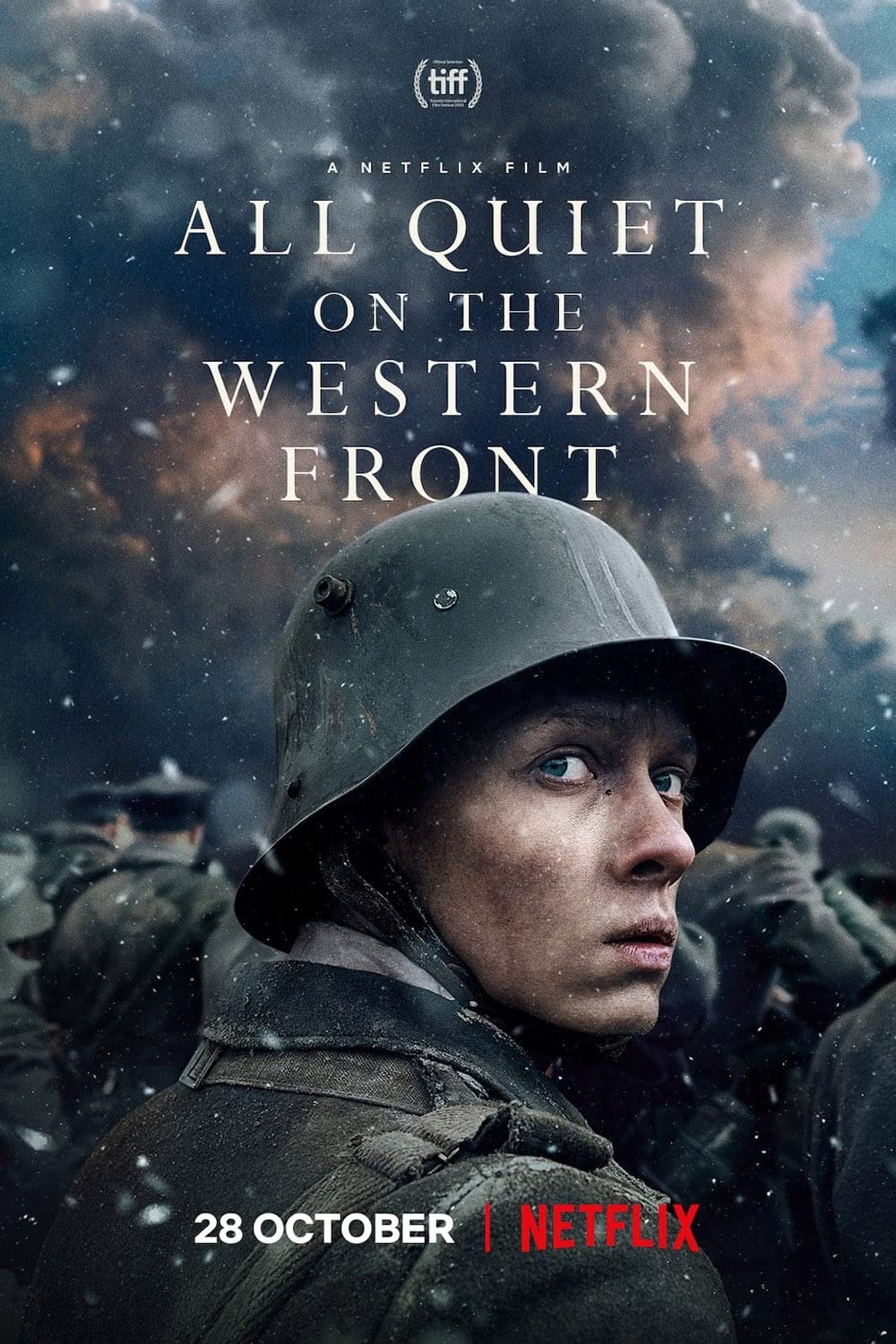

There are war films. And then there are war films. The kind that don’t glorify violence or pretend that heroism is somehow immune to fear, filth, or futility. All Quiet on the Western Front (2022) falls firmly in the latter category. It is brutal. It is quiet. It is relentless. And despite retreading one of the most familiar anti-war stories in cinema and literature, it manages to hit like an artillery shell to the gut. Not because it’s saying anything new—but because it dares to show, without sanitization, what war truly is: a meat grinder that devours idealism, patriotism, and youth alike.
Adapted from Erich Maria Remarque’s seminal 1929 novel, this German-language Netflix production, directed by Edward Berger, drags the viewer through the trenches of World War I with a sensory realism that would make even hardened veterans shift uncomfortably in their chairs. And unlike most Hollywood war flicks where uniforms are spotless and death comes in slow-motion, this version is soaked in mud, blood, and moral ambiguity.
The Innocence That Marches Willingly Into Hell
At the center is Paul Bäumer, a fresh-faced German teenager who, along with his school friends, eagerly enlists to serve the Kaiser. The initial scenes, filled with nationalistic fervor and speeches about glory and honor, are almost parody-worthy in their naiveté—until the film cruelly peels that veneer away. What follows is not a coming-of-age story. It’s a coming-of-despair narrative. Every shred of Paul’s humanity is sandblasted off by exploding shells, trench rats, starvation, and the death of his friends.
This is not war. It is slaughter by appointment. And what makes it more chilling is how quiet it all is. Not in terms of sound design—the explosions and bullets are thunderous—but in tone. There’s no rah-rah soundtrack. No “freedom vs tyranny” speeches. Just survival. Just the cold, institutional machinery of empires sending men to die for borders that will shift again anyway in a generation or two.

Berger’s Brutal Canvas
Edward Berger directs with a certain moral anger, but he never allows the film to become propaganda. There’s no villain with a twisted mustache here. The villain is the war itself—and the bureaucrats in warm, velvet-draped rooms who prolong it. In fact, one of the film’s most effective choices is to juxtapose the mud-caked horror of the trenches with the sterile detachment of Germany’s high command. As Paul starves in a freezing trench, a general eats roast duck and speaks of glory. That contrast is more powerful than any battlefield monologue ever could be.


Felix Kammerer, in his first leading role, delivers an emotionally devastating performance as Paul. He barely speaks. His eyes do most of the talking. They go from hopeful to hollow in a span of minutes. And Daniel Brühl, as the real-life German diplomat Matthias Erzberger, is the only character with any real agency—negotiating an armistice that comes too late for thousands.
Yes, You’ve Seen This Story Before… But Not Like This
Let’s be real—there’s no shortage of war films. Saving Private Ryan, 1917, Paths of Glory, Platoon, Dunkirk—we’ve all seen the horrors of war dramatized before. And if you’re someone who consumes military history like breakfast cereal, you may even find the plot of All Quiet predictable. But it’s not about the plot.

It’s about the experience. Berger doesn’t make a movie you watch. He makes a movie you survive. And by making it German-led—by showing the other side of the war—he strips away the binary “us vs. them” narrative that modern audiences are too used to. There are no heroes here. Just children in uniform, shoved into a hell they didn’t understand and couldn’t escape. And yet—here’s the real triumph—he doesn’t turn it into a nihilist sermon either. There is pain, but also fleeting glimpses of humanity. A shared meal. A laugh in the trench. A stolen moment of silence. These moments shine more brightly because of how dark everything else is.

The Politics of Pain
If you’re expecting a leftist screed about the futility of war or a thinly veiled attack on modern geopolitics—this isn’t that film. All Quiet is too focused, too personal, too intimate to be political grandstanding. It doesn’t scream ideology. It whispers loss. And yet, in a time where war is again raging in Europe—where young men are again being sacrificed for “national interests”—this movie becomes unsettlingly relevant. It’s a reminder that politicians may change, borders may shift, but the cost of war is always paid in youth, trauma, and blood.

As someone who leans right, I’ve always believed in strong defense, in national pride, and in honoring the military. But honoring our soldiers means telling the truth about what they face. Not romanticizing it. And this film does just that. It reminds us that war, when misused or prolonged, becomes a massacre factory. And real patriotism doesn’t come from warmongering—it comes from ensuring we don’t waste lives for the ego of generals or the agendas of empires.

The movie doesn’t reimagine the wheel, but it doesn’t need to. The power of its story is in its honest retelling. This is a war film that understands the meaning of sacrifice without dressing it up in fantasy. It’s a blood-soaked poem. A prayer for peace from the trenches of hell. If you have a soul, it will leave a scar.
JAY’S VERDICT
All Quiet on the Western Front (2022) is not a movie you’ll “enjoy.” It’s not entertainment. It’s confrontation. With history. With humanity. With yourself.