






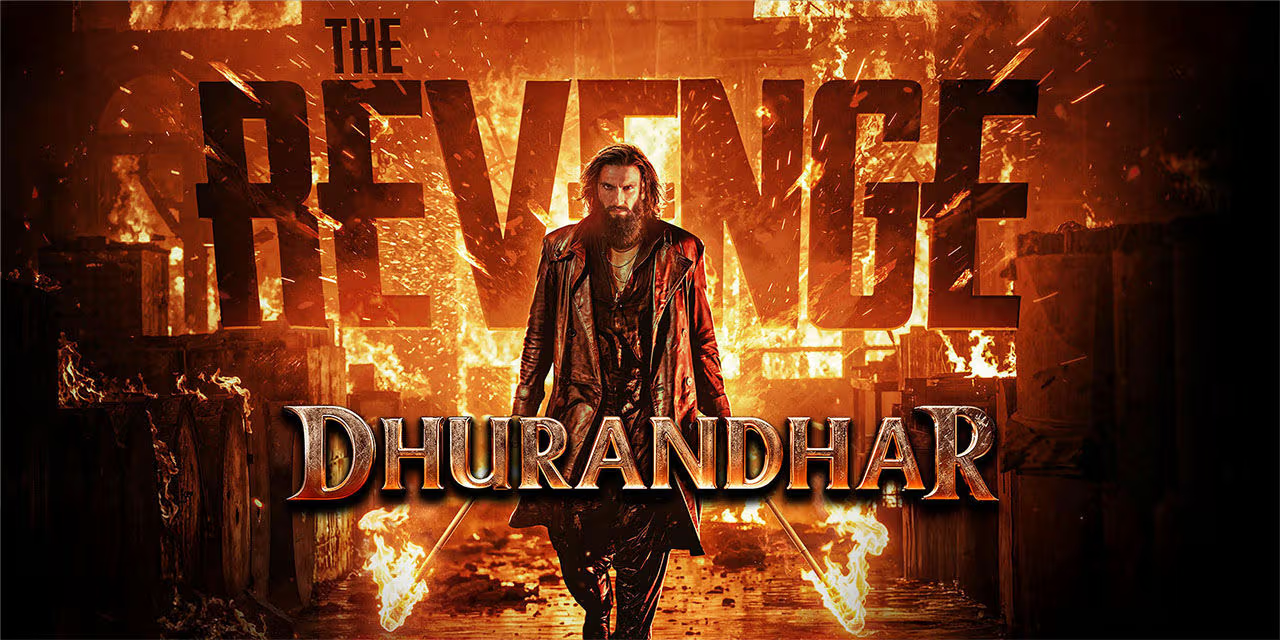

Let us get one thing out of the way immediately. If you are one of those people who watched Dhurandhar and rushed to your keyboard to write a think-piece about “dangerous jingoism” and “propaganda” — congratulations. You have successfully confirmed that you know absolutely nothing about the 1999 IC-814 hijacking, the 2001 Indian Parliament attack, the 2008 Mumbai terror attacks, or the ISI-sponsored terror networks that have been systematically targeting India for over three decades. That is not cinema criticism. That is wilful ignorance dressed in a turtleneck.
Now that we have dealt with that crowd — let us talk about the actual films.
How We Got Here
After Uri: The Surgical Strike turned Vicky Kaushal into a household name and made “How’s the josh?” a national catchphrase, director Aditya Dhar had a choice. Play it safe with a follow-up that would satisfy audiences and studio executives alike. Or go bigger, darker, and infinitely more complex. Dhar chose the latter — and then some.
Dhurandhar is the story of Jaskirat Singh Rangi, a 20-year-old from Pathankot who gets pulled into a covert Intelligence Bureau mission following the IC-814 hijacking and the 2001 Parliament attack. His assignment: infiltrate Karachi’s Lyari underworld, a neighbourhood that in the early 2000s was simultaneously a criminal empire, a terrorist financing hub, and a Pakistani political battleground. He enters as a Punjabi boy. He emerges, over the course of a decade, as Hamza Ali Mazari — and the line between the man and the cover disappears in ways the film refuses to make comfortable.
This is not Uri. Uri was a roar. Dhurandhar is the bite that comes after — slower, more calculated, and considerably more dangerous.

What Pakistan Has Been Doing — And What The West Pretends Not To See
Before we go further into the films, let us spend a moment on the context — because apparently the Western media requires a Bollywood blockbuster grossing ₹3,200 crore to pay attention to things that have been happening for decades. The IC-814 hijacking in December 1999 is where the story begins. Terrorists with documented Pakistan links hijacked an Indian Airlines flight from Kathmandu to Delhi and forced it to land in Kandahar, Afghanistan, then under Taliban control. India was held hostage — literally and diplomatically — for eight days. The price of releasing the passengers was the freedom of three convicted terrorists: Maulana Masood Azhar, Omar Sheikh, and Mushtaq Ahmed Zargar. Masood Azhar walked out of Indian custody and immediately founded Jaish-e-Mohammed, the terrorist organisation that would go on to attack the Indian Parliament two years later and conduct multiple attacks in Kashmir for years after that. The West barely noticed in 1999. It barely notices now.
The 2001 Indian Parliament attack brought suicide bombers and gunmen to the heart of Indian democracy, killing nine people and coming within minutes of assassinating the entire Indian cabinet. Investigations pointed directly to Jaish-e-Mohammed and Lashkar-e-Taiba, both with ISI backing. Pakistan denied involvement. The international community shrugged, issued some statements, and moved on.

Then came 26/11. The 2008 Mumbai attacks over four days in November killed 166 people, wounded hundreds more, and were watched live on television screens around the world. Ten terrorists, trained in Pakistan, crossed by sea from Karachi to Mumbai. They had GPS devices and satellite phones. Their handlers were monitoring from Pakistan and communicating in real time. One of those handlers — a man referred to in FBI documents as Major Iqbal — coordinated with David Headley, a Pakistani-American operative who had conducted reconnaissance of the targets. Headley’s FBI affidavits and subsequent American court proceedings documented the ISI connection with a level of detail that should have been impossible to dismiss. And yet, Pakistan denied involvement, issued some statements, and the world moved on. Again.
Now add to this the counterfeit currency angle that Dhurandhar: The Revenge brings front and centre. This is the part that makes some viewers uncomfortable because it sounds almost too elaborate to be real. It is very real. RAW, the Intelligence Bureau, and the Directorate of Revenue Intelligence have all formally informed India’s Parliamentary Standing Committee on Finance that the ISI prints high-quality fake Indian currency notes — primarily in Rs 500 and Rs 1000 denominations — and circulates them through terror operatives, criminal networks, and even Pakistani diplomatic missions. The ISI has used Pakistan International Airlines and diplomatic bags through missions in Dubai, Kuala Lumpur, Hong Kong, and Doha to transport fake currency into India via Nepal and Bangladesh. The Financial Action Task Force’s own reports have flagged this. The RBI detected over 2.25 lakh fake currency pieces in India in 2023 alone. David Headley reportedly used fake Indian currency notes during his reconnaissance of Mumbai targets before 26/11. This is not a conspiracy theory. This is documented, cross-referenced, and presented to India’s own Parliament.
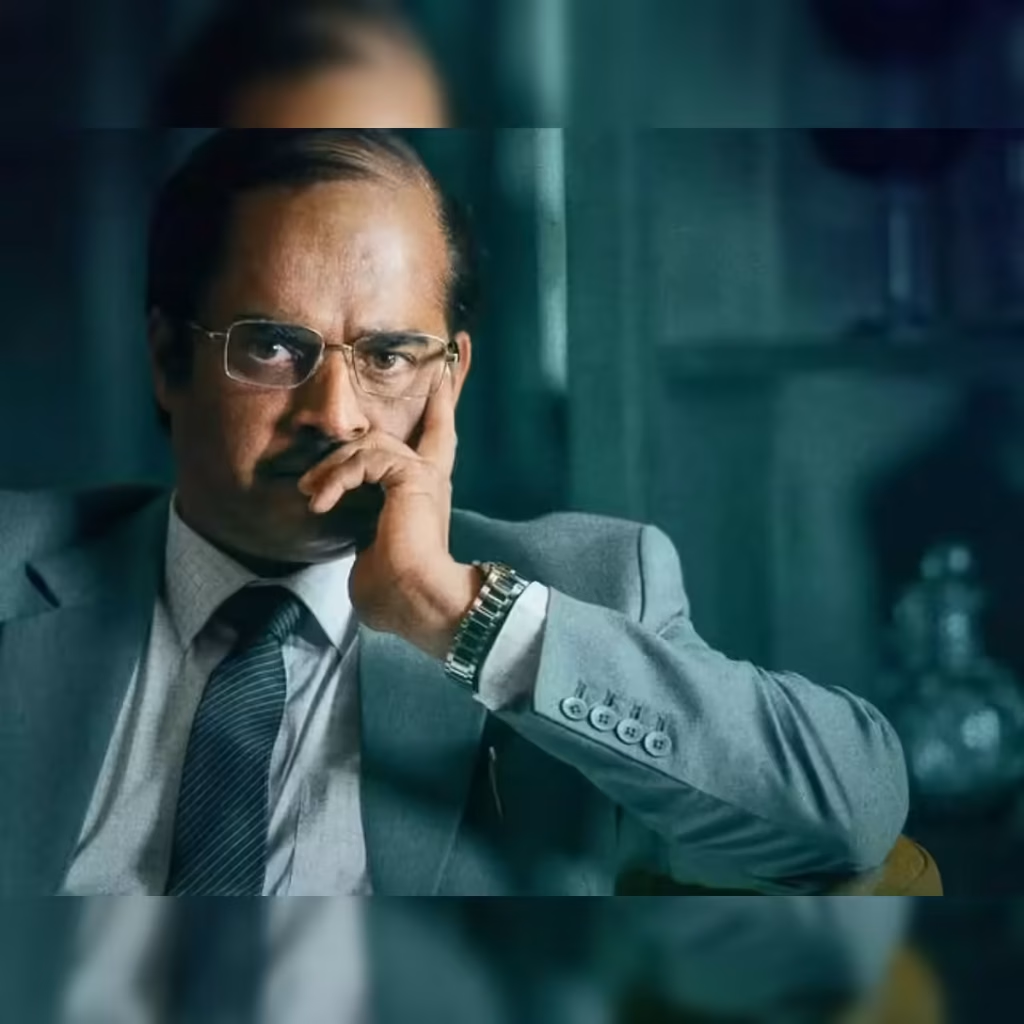
The 2016 demonetisation, whatever its broader economic consequences, was partly designed to collapse this infrastructure — to make the pre-existing fake note supply chain worthless overnight. The film dramatises this connection with cinematic flair. The underlying reality is considerably less dramatic and considerably more disturbing.
The West, which lectures India endlessly about democracy and human rights, has never once held Pakistan meaningfully accountable for any of this. Not for IC-814. Not for 26/11. Not for three decades of fake currency operations designed to destabilise the Indian economy and fund the killing of Indian civilians. Dhurandhar does not ask for the West’s approval or understanding. It simply tells the story. That this makes certain critics uncomfortable says everything about them and nothing about the film.
The Performances — Who Delivered and Who Didn’t

Let us start with the headline: Ranveer Singh has never been better in his career. That is not a statement made lightly. Singh built his stardom on being the loudest, most electric presence in any frame he occupied — Ram-Leela, Bajirao Mastani, Gully Boy. He is extraordinarily good at that register. What nobody was entirely sure he could do was the opposite. Hamza Ali Mazari demands silence, restraint, and a kind of internal devastation that does not announce itself with speeches. Singh delivers all of it. He is quiet in a way that commands your attention precisely because you know the storm underneath. When the mask slips — and there are moments in both films where it does — the impact is genuinely devastating. This is a career-best performance that signals he is far more than a charismatic star. He is an actor.

Akshaye Khanna as Rehman Dakait — based on the real Lyari gangster of the same name — is the performance that will outlast both films in conversation. Khanna has spent years being criminally underused by an industry that kept casting him in roles smaller than his talent. Here he is completely unleashed. His Rehman is magnetic, menacing, and layered in ways that genre films rarely allow their antagonists to be. You understand him. You even enjoy his company, which makes the moments where his violence surfaces all the more unsettling. His improvised dance sequence to an Arabic number became one of the film’s most viral moments — it is the scene of a man performing power for an audience, which is exactly what Rehman Dakait would do. It is the film’s most unexpected scene and one of its best.
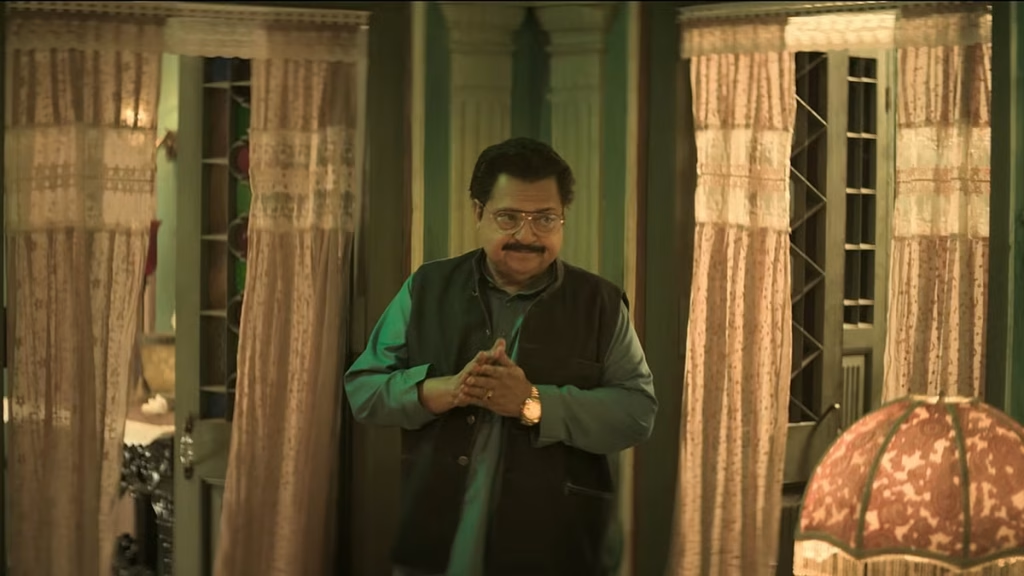
Then there is Rakesh Bedi. At 71, a man Indians know primarily from his comic television roles in Yeh Jo Hai Zindagi, Shrimaan Shrimati and decades of beloved supporting work, walks into Dhurandhar and quietly steals entire sequences from everyone around him. His Jameel Jamali — a slippery Karachi politician who smiles too much and means none of it — is a masterclass in the art of performed affability hiding calculated menace. Bedi studied Pakistani political figures for the role, focusing on speech patterns, gestures, and the particular body language of men who have survived long careers in dangerous places by being charming at exactly the right moments. He also suggested adding subtle humour to certain scenes, which Dhar was initially hesitant about. He was right to push for it. The humour makes Jamali more frightening, not less — because it is the humour of a man who has decided nothing can touch him. The reveal in The Revenge regarding Jamali’s true allegiances is the film’s most satisfying narrative twist, and it lands as hard as it does entirely because of the groundwork Bedi laid across seven hours of screen time. This is the role of his career. Nobody saw it coming. Everyone should have.
R. Madhavan as Ajay Sanyal — the unmistakable fictional stand-in for NSA Ajit Doval — carries the film’s moral and strategic weight with quiet, unshowy authority. Madhavan is the kind of actor who makes complex exposition feel like human conversation, which is a skill that is harder than it looks. He is not given the flashiest role in either film, but he is arguably the most essential one — the still centre of a very violent storm.

Sanjay Dutt as the Karachi cop inspired by the real Chaudhry Aslam Khan is gruff, funny, and genuinely affecting in ways that catch you off guard. Dutt at his best has always had a wounded quality underneath the physical presence, and the role gives him room to use it. His scenes with Singh have an unexpected warmth that provides emotional breathing space in an otherwise relentless film.
Arjun Rampal as Major Iqbal — the ISI handler based on the real figure who appears in FBI affidavits related to David Headley — is cold, precise, and genuinely frightening. Here is where we must be honest, however. Rampal is effective rather than exceptional. He has the physicality and the presence for the role, and he does not drop the ball. But in a film where Singh, Khanna, and Bedi are all operating at career-best levels, Rampal’s Iqbal registers as the one major performance that does not quite elevate the character beyond what is written on the page. He delivers the role as designed. He does not transcend it.
Sara Arjun as Yalina Jamali is fine in a role that the script does not particularly serve. She is given enough to work with in the first film to establish character and not nearly enough in the second to deepen it. That is a writing issue more than a performance issue, but the result is the same — she is largely peripheral in a story where every other major character has a meaningful arc.
The Cinematic Experience — Why These Films Work
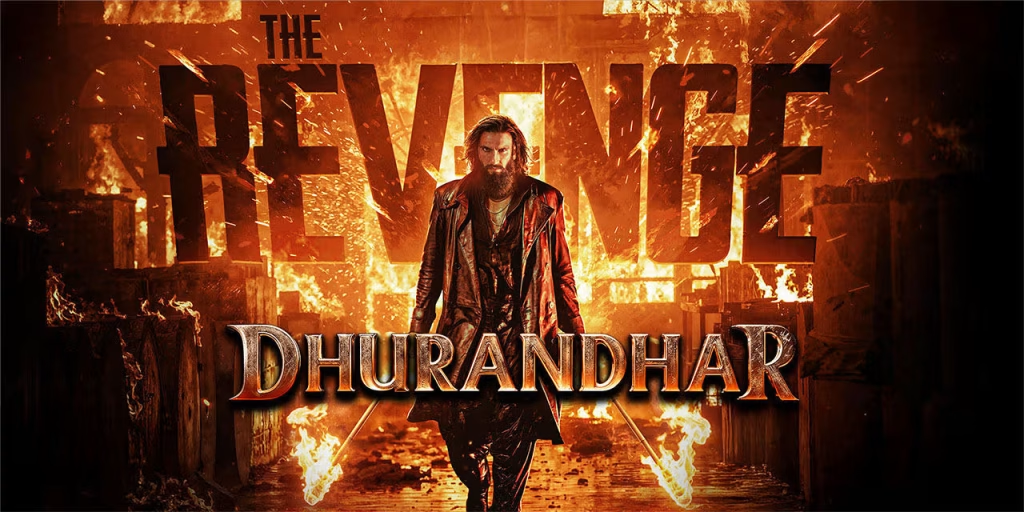
Beyond the politics, beyond the performances, these are films that are genuinely thrilling to watch — and that is worth spending time on because it is what actually determines whether you sit through seven combined hours. The first film is structured in chapters, each one peeling back another layer of Lyari’s underworld. Dhar takes his time, which will test the patience of anyone expecting relentless action. What he builds instead is a suffocating atmosphere — the claustrophobia of a man trapped between two identities, the texture of Karachi’s streets recreated in Bangkok with remarkable production design, and a web of supporting characters complex enough that you find yourself invested in people whose moral standing is deeply questionable. The action sequences, when they arrive, are brutal and grounded in a way that feels deliberate — these are not superhero fights, they are ugly, exhausting, and sometimes horrifying. At three hours and thirty-four minutes, it is long. It rarely feels it.
Shashwat Sachdev’s background score deserves its own paragraph. It does the thing a great score is supposed to do — it tells you what a character is feeling when the performance deliberately withholds it. There are moments in the first film where the music is doing half the emotional work, and it earns every bit of that weight.

Dhurandhar: The Revenge is a different proposition. Where the first film is a slow burn, the sequel is the explosion at the end of a very long fuse. The action is bigger, the violence considerably more graphic, and Dhar essentially gives himself permission to be operatic in ways the first film restrained. Ranveer Singh carries this film on pure performance — this is his movie in a way the ensemble nature of the first did not quite allow. The payoff to the seven-year covert mission lands with genuine emotional weight, and an Arijit Singh number near the closing act hits harder than it has any right to. The post-credits scenes leave the door open for continuation and manage the impressive feat of making you simultaneously satisfied with the conclusion and curious about what comes next.
Is The Revenge the better film? No. Is it a satisfying and frequently spectacular conclusion to one of the most ambitious projects Hindi cinema has attempted? Without question.

The Critics Who Missed the Point
Some critics called this propaganda. Some called it dangerously nationalistic. At least one called it a “techno-jingo gorefest,” which is an excellent phrase that tells you considerably more about the critic than the film. Here is the thing. You can simultaneously acknowledge that Dhar’s politics sit front and centre, that the films occasionally tip into sloganeering, and that the fictional elements are presented with more bombast than nuance — and also accept that the bedrock these films stand on is documented, cross-referenced historical reality. These are not mutually exclusive positions.
What the anti-India brigade globally refuses to do is apply their scepticism evenly. A BBC documentary built on selective testimony from politically motivated sources is journalism. A Bollywood film backed by an NDTV national security editor who made a documentary about the 2022 assassination of an IC-814 hijacker — and grounded in FBI affidavits, FATF reports, Parliamentary committee testimony, and court records — that is the propaganda. The irony is rich enough to eat with a spoon.

Where to Watch
Dhurandhar is currently streaming on Netflix globally — including India, the US, Canada, and the UK. One honest caveat: the Netflix version has some dialogue muted and minor edits made for streaming. It is a minor irritant rather than a material change to the film, but purists who can still catch it in a cinema where it is playing should do so. Dhurandhar: The Revenge heads to JioHotstar, with industry reports pointing to a late May or early June 2026 OTT window following its theatrical run. Satellite rights went to Star Gold. Given we are now in June 2026, that streaming window is effectively here.
JAY’S VERDICT
Dhurandhar and Dhurandhar: The Revenge are not perfect films. They are long, occasionally self-indulgent, and Aditya Dhar’s politics are never far from the surface. But they are important films — and more to the point, they are genuinely gripping, beautifully performed, and technically accomplished in ways that Indian cinema has rarely attempted at this scale. Ranveer Singh has never been better. Akshaye Khanna has never been better used. Rakesh Bedi at 71 delivered a performance that will be talked about long after the box office numbers are forgotten. And Aditya Dhar has confirmed that he is not a one-film director. He is the real thing. The combined ₹3,200 crore box office — making this the highest-grossing Indian franchise of all time — tells you that actual audiences, as opposed to keyboard critics in turtlenecks, understood exactly what they were watching.
Part 1 is on Netflix right now. Part 2 hits JioHotstar imminently. Watch both. Clear your schedule. And if someone tells you it is propaganda — ask them what they know about IC-814, Major Iqbal, the FATF reports on Pakistani fake currency, and Operation Lyari.
The silence will tell you everything.


