



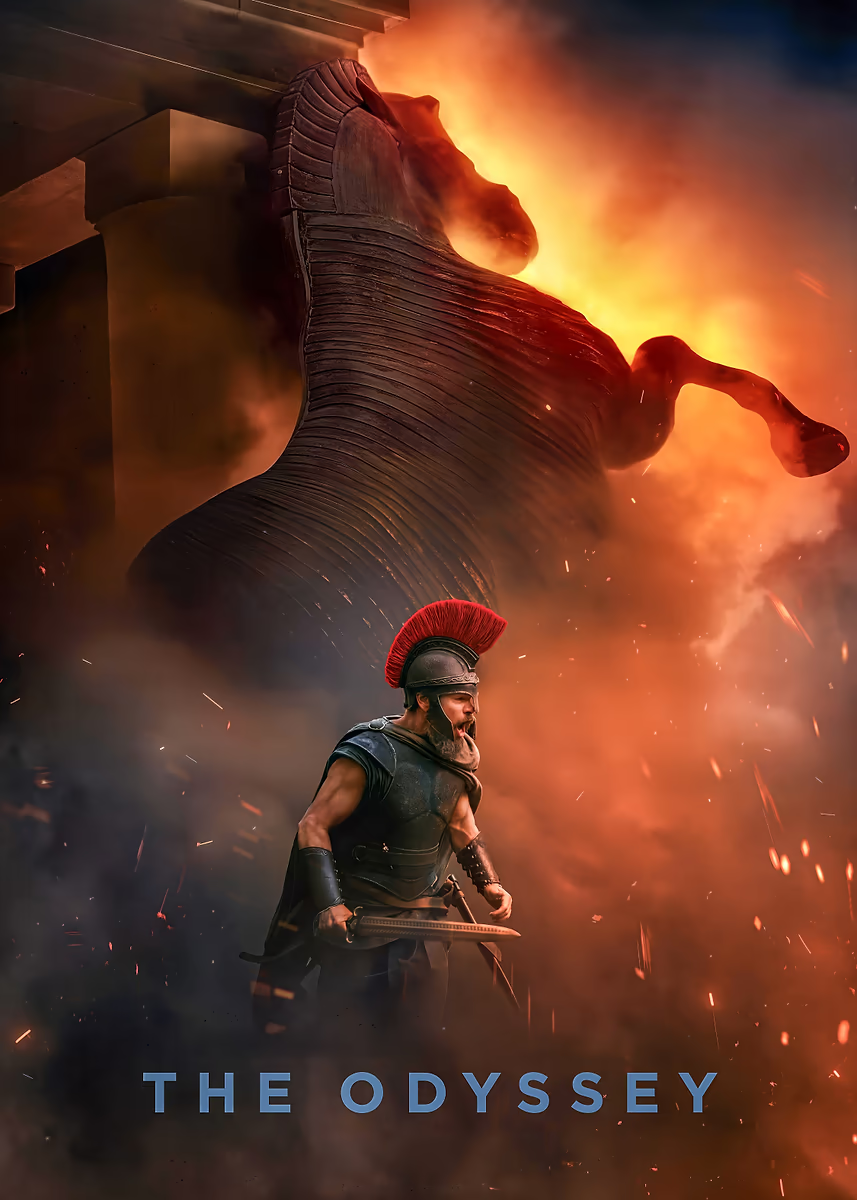

Christopher Nolan doesn’t do small. He shot an entire war epic on IMAX 70mm film, dragged an A-list ensemble across the Peloponnese, and slapped a $250 million budget on top of Homer’s 2,700-year-old poem. On paper, that’s the kind of ambition I want to see rewarded. In practice, The Odyssey is a film that looks like a masterpiece and talks like a Netflix family drama that wandered onto the wrong set.
The Visuals Are the Movie
Let’s start with what actually works, because there’s a lot of it. Shot entirely on IMAX film, The Odyssey is gorgeous in the way only Nolan can make gorgeous — not flashy, not over-lit, just massive. The scale of it hits you physically. Cyclops caves, storm-torn seas, the plains outside Troy — every frame looks like it cost what it cost. This is the guy who still shoots practical when everyone else reaches for a green screen, and it shows: the texture on Polyphemus’s cave, the weight of real ships on real water, the way light actually falls across the Peloponnese instead of being pumped in during post. Nothing here has that weightless, slightly-fake sheen of a modern blockbuster. When Odysseus’s fleet gets battered by a storm, you believe the boats are actually being battered. If you’re watching this anywhere other than the biggest screen your city has, you’re doing it wrong. This is a film built for the format, and on that level alone, it delivers — Nolan’s commitment to shooting it real, on film, on location, is the single best decision made on this production.
And Matt Damon, credit where it’s due, is genuinely good as Odysseus. He plays the character with the right mix of exhaustion and cunning — a man who’s been fighting and lying his way home for a decade and has the eyes to prove it. He’s the one performance in this ensemble that actually understands what the movie is supposed to be about.
Two Movies Stitched Together, and Only One of Them Works
Structurally, Nolan splits the runtime almost evenly between two threads. Back on Ithaca, it’s been eight years since the war ended and most of Greece has written Odysseus off as dead. Telemachus (Tom Holland), who never even met his father, refuses to accept that. Penelope (Anne Hathaway) is stalling off Antinous (Robert Pattinson) and a palace full of suitors who’ve moved in, eaten the family out of house and home, and are now maneuvering to cut Telemachus out of the throne entirely. Meanwhile, on Calypso’s island, Odysseus is a comfortable prisoner, and it’s through his recollections to her that we get the actual mythology — the Cyclops Polyphemus, Circe turning his men into pigs, a trip to the underworld to consult the blind prophet Tiresias, the Laestrygonian giants wrecking his fleet.
That’s a clever structural idea on paper — the homecoming and the journey unfolding side by side instead of in sequence. The problem is execution. The Ithaca half is almost entirely palace intrigue and conversation: suitors scheming, Penelope stalling, Telemachus brooding. It’s the political-drama version of The Odyssey, and it eats far more runtime than it should, given that the other half of the film is sitting on cyclops and sirens and literally has to visit hell. Every time the film cuts back to Ithaca, you can feel the air go out of the room.

Where’s the Myth in the Mythology?
Here’s my problem, and it’s a big one: The Odyssey is supposed to be the original hero’s journey — cyclops, sirens, witches turning men into pigs, the underworld. It’s the most mythologically stacked text in Western literature. And Nolan, somehow, treats all of it as an inconvenience to get through between conversations. The film spends far more time on people talking in rooms and on ships than it does on the encounters that made this story worth adapting in the first place. You go into an Odyssey movie wanting the Cyclops and the Sirens to be the main event. Instead they’re rushed past like a director eager to get back to dialogue scenes.
Nowhere is this more infuriating than the fall of Troy itself. Nolan shoots it in these near-abstract flashes — the horse half-buried on the tideline like a wreck washing ashore, fire glimpsed in fragments rather than staged as the full-scale sack of a city. I understand the artistic instinct to make it impressionistic rather than a standard action beat, but this is the single most consequential event of the entire war, and it’s over almost before you register it happened. Same with the Laestrygonian giants — an attack that should be a terrifying, fleet-destroying set piece gets compressed into what feels like ninety seconds of screen time. Ships get smashed, men die, and we’re already moving on to the next scene of people talking in a room. For a three-hour movie, the editing consistently shortchanges exactly the wrong scenes.

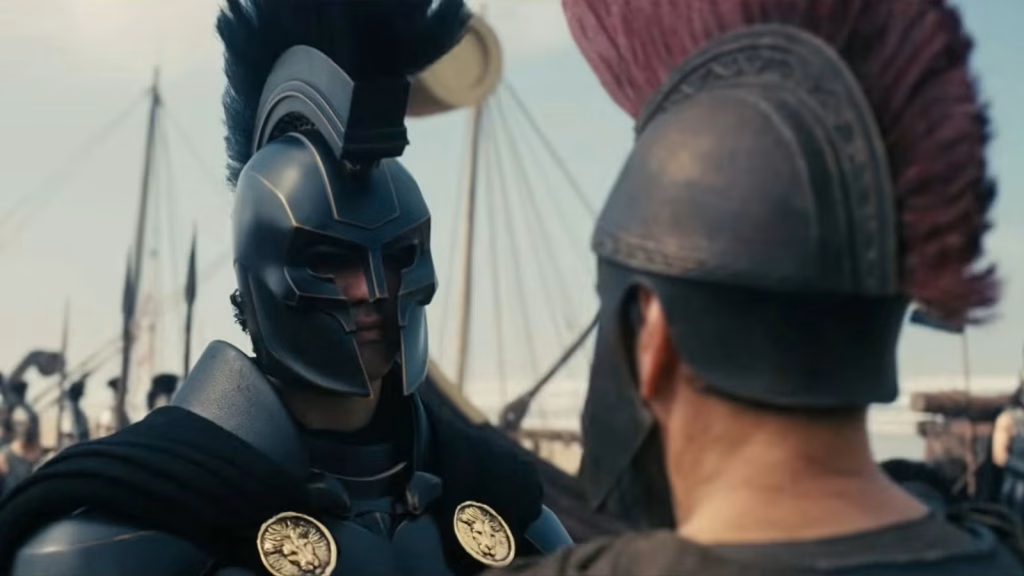
And the costuming doesn’t help sell any of it. The Hellenic armor and helmets throughout look like they came off a fantasy-adjacent assembly line rather than anything grounded in actual Bronze Age Greece — too clean, too uniform, more generic “ancient warrior movie” than the specific, brutal, boar’s-tusk-and-bronze aesthetic this era actually had. Compare it to what Wolfgang Petersen’s Troy did two decades ago with a fraction of the budget, and it’s a genuine step backward. When you’re spending $250 million and shooting on IMAX film that captures every stitch in painful detail, the costume department needed to be operating at the same level of ambition as the cinematography. It wasn’t.
And that pacing problem compounds itself. At nearly three hours, this movie feels every minute of its runtime — not because the story is dense, but because it keeps stalling on scenes that don’t earn the screen time they’re given.

Homer Wrote It Sexier Than This
One more thing missing that genuinely surprised me: the eroticism. Homer’s Odyssey is not a chaste text. Circe and Calypso aren’t just obstacles — they’re seductions, women who keep Odysseus in their beds for a year and seven years respectively, and the temptation of staying is the actual narrative engine of that entire stretch of the poem. The Sirens’ song is dangerous because it’s alluring. Nolan’s version strips almost all of that out. Calypso’s hold over Odysseus here is handled less like romantic captivity and more like a chemical dependency — she keeps him amnesiac using lotus flowers rather than through any real longing or seduction, which turns a genuinely charged mythic relationship into something closer to a medical plot device. It’s a strange choice for a film that otherwise wants to be taken seriously as a faithful, adult adaptation — Homer wasn’t shy about desire, and Nolan, for all his ambition here, clearly is.

The Characters Deserved More Room
Credit where it’s due: when the film slows down long enough to actually build someone, it can. Tom Holland’s Telemachus is a genuinely solid piece of casting — a young man who grew up entirely in his father’s shadow without ever meeting him, caught between grief and a refusal to accept it, and Holland plays the transition into someone capable of standing beside Odysseus with real conviction. Anne Hathaway’s Penelope gets less to do than she should, but what she has, she uses well — there’s real steel under the patience, a woman running a court under siege by suitors while keeping her son alive through sheer will. Samantha Morton’s Circe is the best pure performance in the film outside of Damon — genuinely unsettling, more body horror than seductress, which undercuts the sensuality point above but at least makes her the one supernatural encounter that actually lands as frightening. And Jon Bernthal, in limited screen time as Menelaus, brings a cynical, war-worn energy that the rest of the ensemble could have used more of.
The problem is that these are exceptions in a cast this large, and the film doesn’t give itself enough time with any of them because it’s too busy cutting back to palace intrigue or, worse, making a point.

When the Movie Argues With Its Own Choices
For a cast this loaded, shockingly little of it lands, and some of what doesn’t feels like it’s there to make a statement rather than to serve the story. Zendaya, playing Athena, is asleep at the wheel — a goddess who’s supposed to be Odysseus’s sharpest ally comes across flat and disengaged, like she wandered in from a different, lower-stakes movie. Elliot Page, cast as Sinon, a Greek soldier whose entire mythic function is to trick the Trojans into hauling the horse inside their walls, simply doesn’t convince. That role needs someone who reads as a hardened veteran capable of pulling off the single greatest con in ancient literature, and the film never does the dramatic work to build that credibility — the casting reads like a decision made for reasons outside the character, and the movie never proves otherwise.
The Helen material has the same problem in reverse. There’s a whole beat where other characters openly mock the legend that Helen’s face launched a thousand ships while Lupita Nyong’o’s Helen bears a visible scar — and given that her casting drew its own round of online backlash before the film even released, that scene plays less like organic myth-interrogation and more like Nolan pausing the movie to argue with people who weren’t even in the room. I don’t need my Greek epic to editorialize about its own casting news cycle. I need it to tell me the story. Whatever point the film thinks it’s making there, it stops the momentum cold to make it, and that’s true whether the point lands with you or not.

And then there’s the dialogue, which is where The Odyssey really loses the plot. In the middle of ancient Ithaca, surrounded by gods and monsters and a decade-long war, characters casually drop lines like “my dad” and “mom.” It’s jarring in a way that pulls you completely out of the world Nolan spent $250 million building. This is Homeric Greece — it needs language that at least gestures toward the weight of the material, not modern American shorthand that belongs in a suburban dramedy.
It’s not that the rest of the ensemble is bad across the board — Robert Pattinson makes Antinous appropriately slimy as the lead suitor angling to marry Penelope and erase Telemachus from the succession. But those flashes only highlight how inert everything around them is.

A Faithful Adaptation That Doesn’t Feel Faithful
The strange thing about The Odyssey is that it manages to feel both too loyal to its source and completely disconnected from what makes that source compelling. It hits the major beats — Troy, the Cyclops, Circe, Penelope waiting at home — but drains them of the mythic energy that’s the entire point of the story. Homer’s Odyssey isn’t a domestic drama with occasional monsters. It’s a monster story with a homecoming at the end. Nolan inverts that ratio, and the movie suffers for it.
The Odyssey is a film I respect more than I enjoyed. The craft is undeniable — this is IMAX filmmaking at its most technically accomplished, shot practical and on location in a way almost nobody else in this budget range still bothers with, and Matt Damon anchors it with a performance that understands the assignment. But a story built on cyclops, sirens, and the underworld should not feel like its best moments are the dialogue scenes in between. Splitting the runtime between palace politics on Ithaca and Odysseus’s actual mythic journey was a smart structural idea that Nolan doesn’t have the discipline to execute — the political half swallows too much of the film’s oxygen, Troy burns and the giants attack in scenes so compressed they barely register, and the costuming never rises to the level of the cinematography around it. Add a genuinely flat Zendaya, a miscast Elliot Page, a Helen subplot that seems more interested in answering casting discourse than building myth, a version of Circe and Calypso stripped of the seduction that made them dangerous in the first place, and dialogue that occasionally forgets it’s set in ancient Greece, and you get a movie that’s spectacular to look at and frustrating to sit through.
JAY’S VERDICT
Three hours for twenty years of absence should have room for the homecoming, the myth, and the characters underneath both. Nolan gives you the homecoming in full, the myth in fragments, and lets a handful of good performances — Holland’s Telemachus, Hathaway’s Penelope, Morton’s genuinely unnerving Circe — get buried under everything else competing for attention. Watch it on the biggest screen you can find. Just don’t expect the myth, or the people living inside it, to get the room they earned.