




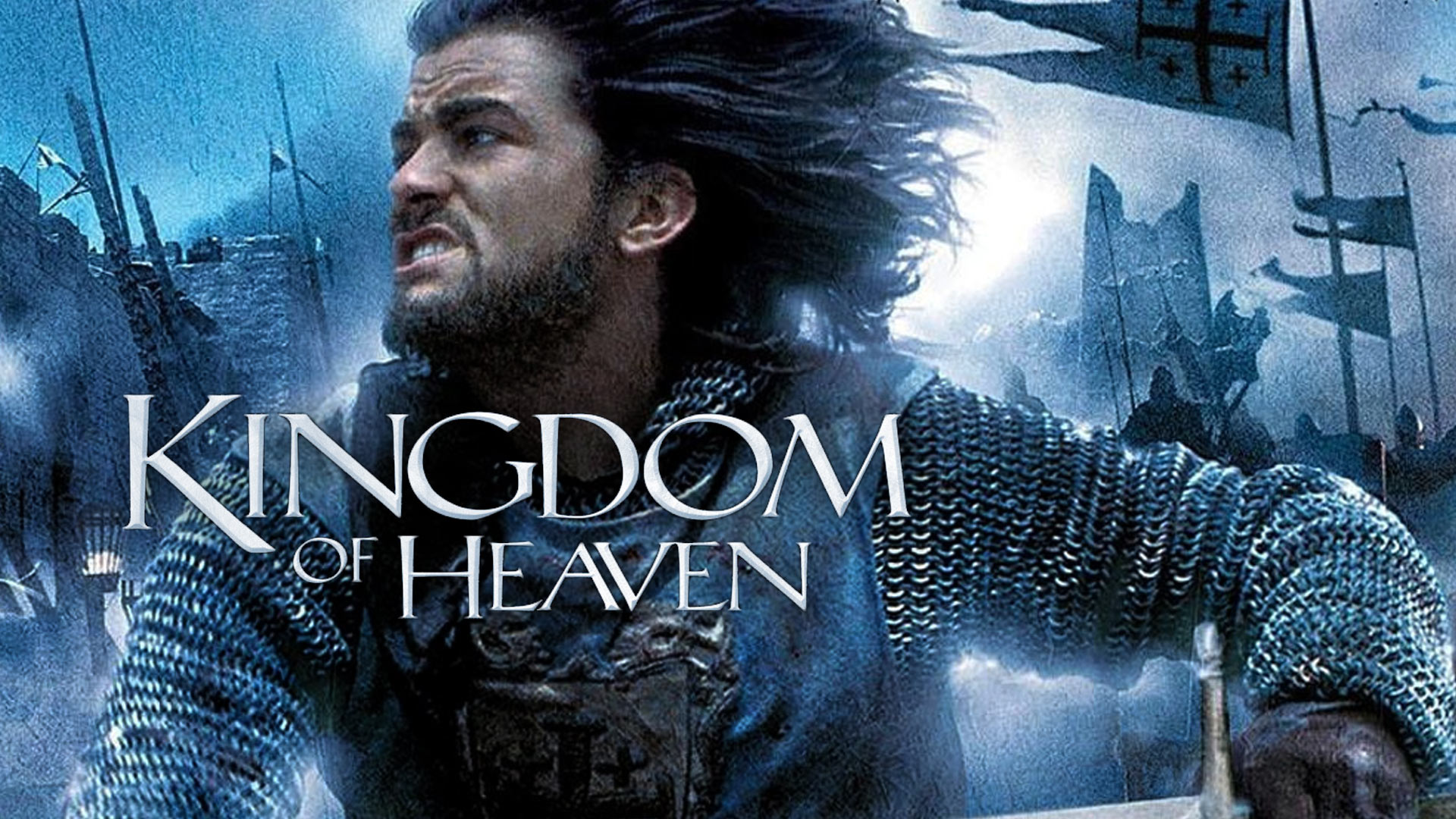

Kingdom of Heaven is a 2005 epic historical drama film directed and produced by Ridley Scott. It features an ensemble cast including Orlando Bloom, Eva Green, Jeremy Irons, David Thewlis, Brendan Gleeson, Marton Csokas, and Liam Neeson. The film is a portrayal (fictionalized) of the events leading to the Third Crusade, focusing mainly on Balian of Ibelin who fights to defend the Crusader Kingdom of Jerusalem from the Ayyubid Sultan Saladin.
The movie begins in medieval France. Balian, a blacksmith haunted by his wife’s suicide after the death of their unborn child, meets a group of Crusaders led by Baron Godfrey — a man who claims to be Balian’s father. Initially hesitant, Balian ultimately joins them after killing the town priest (his own half-brother) in a fit of grief and rage. Seeking redemption, he sets out for the Holy Land.
This early arc — loss, guilt, and the pursuit of redemption — is where Kingdom of Heaven distinguishes itself from other historical epics. Unlike most films of its genre, it isn’t concerned with simplistic good-vs-evil binaries. It is obsessed with morality in grey zones — the space where idealism must wrestle with pragmatism.

A HOLY LAND CURSED BY MEN
After a deadly encounter en route and a shipwreck, Balian arrives in Jerusalem. By the time he reaches his inherited estate at Ibelin, he’s witnessed enough war, betrayal, and misery to understand that the Crusader states are built on fragile alliances and even more fragile egos.
The film’s Jerusalem is not the city of divine revelation. It is a political chessboard held together by the will of King Baldwin IV, the leper monarch played with haunting brilliance by a masked Edward Norton. Baldwin is one of the few characters in the film with clarity — a dying king who understands that faith without restraint becomes fanaticism. Here, Scott does something clever: he makes a leper the symbol of tolerance, and a priestly class the harbingers of blood. In that reversal lies the film’s moral punch.

POWER, FAITH, AND THE FAILURE OF MEN
Despite constant provocation from Guy de Lusignan and the psychotic Raynald of Châtillon — the Templar warmonger who treats Muslims like animals — Baldwin maintains an uneasy peace with Saladin. But peace requires maturity, vision, and restraint — qualities in short supply among men drunk on divine legitimacy. After Baldwin’s death and the heart-wrenching demise of Sibylla’s son (whom she poisons to spare him a lifetime of leprosy and political corruption), the crown falls into the hands of Guy — a man who doesn’t seek peace, but vengeance.
Here the story spirals into its inevitable tragedy. Guy’s disastrous decision to march the Crusader army into the desert — to provoke a war with Saladin — leads to the Battle of Hattin, a catastrophic defeat for the Christians. Raynald is executed. Guy is spared. Jerusalem stands alone. It is now up to Balian, once a blacksmith, to defend a kingdom against the full force of Saladin’s army.

INTELLIGENCE OVER DOGMA
The siege of Jerusalem is one of the most brilliantly staged sequences in Ridley Scott’s entire career. Balian, armed with no formal military training, uses engineering knowledge, tactical positioning, and the will of the people to mount a defense against overwhelming odds. But more than the tactics, it’s Balian’s humanity that shines. He knights every able-bodied man — not because he needs them to fight, but because he wants them to die with honor if they must. This democratization of chivalry is symbolic — that nobility is not a birthright, but a choice to serve something greater than oneself.
When the walls begin to fall and the final battle seems inevitable, Balian negotiates with Saladin — offering a peaceful surrender in exchange for safe passage of the city’s citizens. Saladin agrees. This is the soul of the film. Not war for conquest. But war as a test of conscience.

SALADIN – THE DIGNIFIED FOIL
Ghassan Massoud’s portrayal of Saladin is one of quiet strength and dignity. He’s not a caricature of an Arab leader. He is noble, pragmatic, ruthless when needed, and yet deeply spiritual. He is, in many ways, the mirror of Balian. And Scott doesn’t fall into the Hollywood trap of glorifying one side at the expense of the other. Instead, he draws a world where arrogance is punished and mercy remembered.
“What is Jerusalem worth?”
“Nothing… everything.” – Saladin
In that single line, Saladin expresses the essence of the film — that kingdoms rise and fall, but human dignity, mercy, and restraint matter far more than any relic or wall.

MODERN PARALLELS – A CAUTIONARY TALE
Here’s where you’d expect me to make the leap — and I will. In 2025, the echoes of this story remain deafening. Political leaders still weaponize religion for conquest. Extremist ideologies are still cloaked in righteousness. Fanatics still slaughter in the name of God while the wise die trying to keep peace alive. And like the leper king, the voices of moderation are fading — drowned out by populism, vengeance, and ego.
Kingdom of Heaven, in its Director’s Cut, is not just an underrated epic — it is a warning. That when power is handed to fools and fanatics, entire civilizations burn. That peace, though fragile, is always harder and nobler than war. That history’s lesson is clear — arrogance loses. Always.

The theatrical cut may have neutered the film’s complexity, but the Director’s Cut of Kingdom of Heaven is Ridley Scott at his best — philosophical, political, visual, and brutally honest. No film about the Crusades has ever felt this morally conflicted. No war movie has treated faith with such reverence and criticism simultaneously. No epic has made the audience question: Would I fight for the right thing — or just what I was told was right?
JAY’S VERDICT
The Director’s Cut removes many of the flaws of the theatrical version especially the rushed plotlines. This is as an epic ought to be – get yourself a copy now! And ask yourself: what would you have done, when the Kingdom of Heaven was in your hands?