



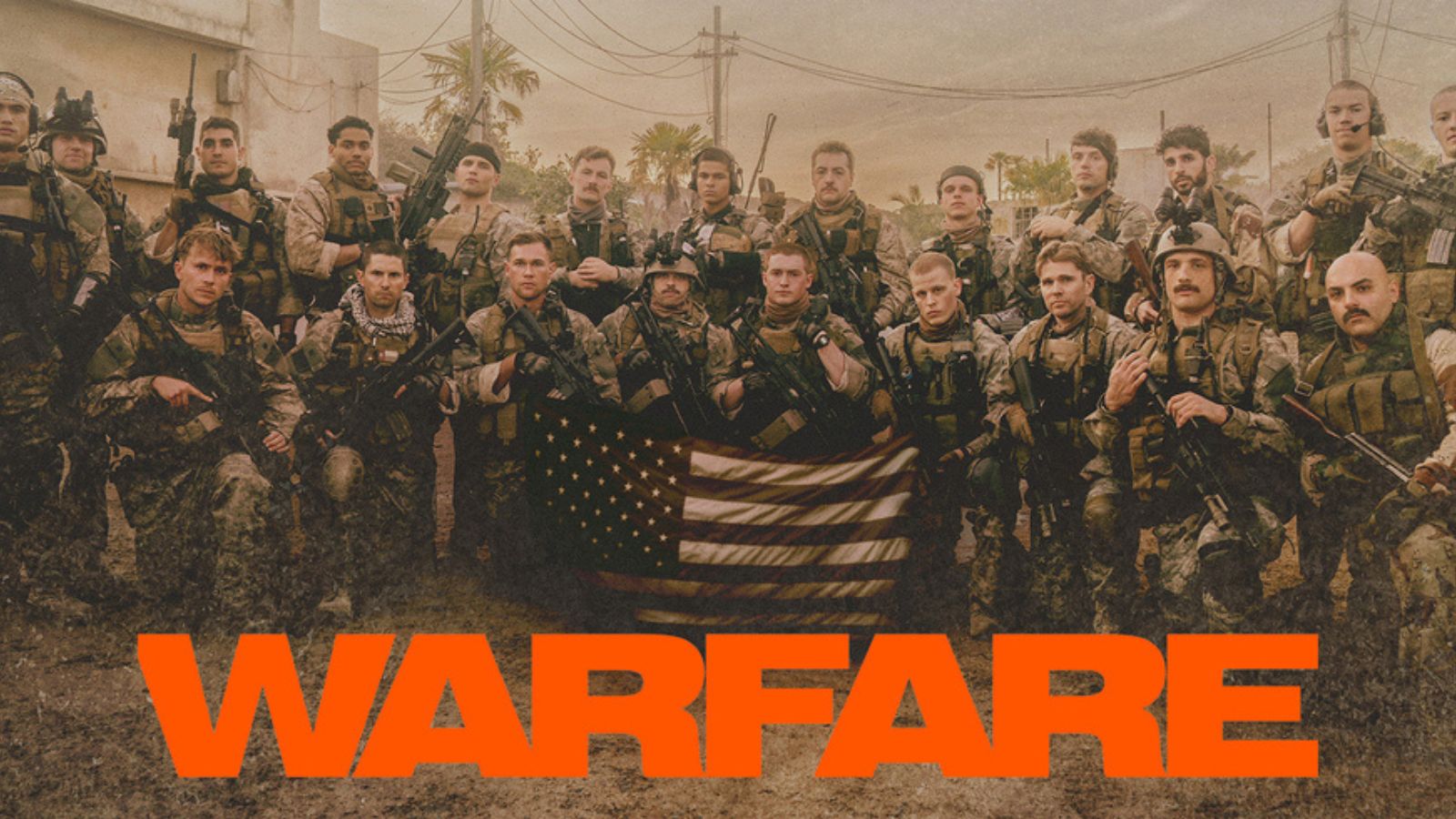

Let’s not pretend this is just a war movie. Warfare, directed by Alex Garland and Ray Mendoza, isn’t fiction. It’s memory disguised as cinema — and not just the memory of a soldier in Ramadi, Iraq, in 2006 — but of an entire generation fed on Western lies, global manipulation, and imperial delusion dressed as democracy.
Shot in real-time and devoid of musical score, Warfare drops you into the chaos of an American SEAL team as their mission collapses into blood-soaked mayhem. It doesn’t try to entertain you. It dares you to sit with the truth — not just the truth of bullets and IEDs, but of who the West becomes when it pretends to save the world.

MEMORY AS PROPAGANDA, MEMORY AS PENANCE
Ray Mendoza, a former Navy SEAL himself, co-directs this based on his own battlefield memories. No glorification. No melodrama. Just adrenaline, fear, and survival. And here lies the brilliance — Warfare refuses to be a Michael Bay military porn fantasy. It’s shot like trauma: jagged, disorienting, real.
But let’s not kid ourselves — the Western media will celebrate this as “bold storytelling” and a “humane look at soldiers.” They will applaud how “real” it feels. But they won’t ask the hard question:
Why was America even there?
Where is the self-reflection on the catastrophic regime change policy that left behind a trail of failed states — from Iraq to Libya? Where is the condemnation of the false intelligence, the drone strikes on civilians, the black sites, the torture, the destruction of ancient cities in the name of “freedom”?
Warfare opens the wound, yes — but the bandage is still dipped in the red, white, and blue of the American flag.

WHEN MEDIA PLAYS GOD AND THE WEST STAYS BLIND
Let’s talk hypocrisy.
Western media — the same BBC, Guardian, and Al Jazeera that love lecturing India about “human rights” and “authoritarianism” — have rarely turned their gaze inward with the same venom. The illegal invasion of Iraq under fabricated WMD claims? A million dead. But you won’t find four-part documentaries calling George W. Bush a war criminal on BBC Prime Time.
Yet the same outlets will spend every second week publishing hit pieces on India, Modi, or Hindu nationalism. They’ll cry over Kashmir, but stay mute on Mosul. They’ll weep for Gaza (selectively), but never mention what happened in Fallujah when the “liberators” rolled in. They’ll dramatize India’s CAA while ignoring the thousands of civilians killed by American air raids in “surgical strikes” that never made the news.
Warfare forces you to see that American war is not noble. It’s dirty. It’s chaotic. It’s morally grey. But what’s more disturbing is this: it’s normalized.
RAMADI AS A METAPHOR FOR AMERICAN HUBRIS
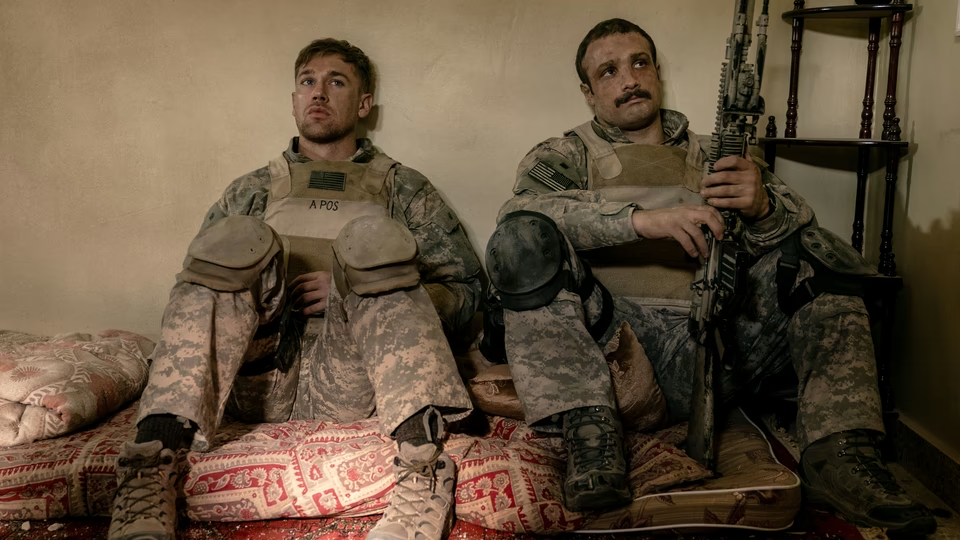
The house the SEALs occupy in Warfare becomes a metaphor for Iraq itself — a place they never truly understood, trying to control chaos they helped unleash. There’s no enemy character development, no ideological battle. Because in this war, ideology is irrelevant. It’s not Islam versus democracy. It’s fire versus fire. The enemy has no face because that’s how America sees its opponents — as shadows, insurgents, problems to eliminate.
Meanwhile, the soldiers — mostly young, working-class men — are stuck in a hell forged by elites who never bleed. They are pawns sent to destroy a country based on lies crafted by Ivy League think tanks and cheered on by Pulitzer-winning war hawks at The New York Times. The camera doesn’t flinch, and neither should we. But don’t confuse this with heroism. It’s survival. It’s instinct. And it’s damn hard to stomach.

THE WEST’S SELECTIVE EMPATHY AND THE GLOBAL SOUTH’S SILENCE
Why isn’t Warfare being shown in classrooms in London, Paris, or Washington? Because it would shatter the myth of moral superiority the West so desperately clings to. It would force Europeans and Americans to reckon with their modern colonialism — not with boots, but with drones, data, and disinformation. Let’s flip the script: Imagine an Indian film made about a military botched operation in Manipur or Kashmir. Would The Guardian call it “a masterclass in moral ambiguity”? Or would it immediately label it state propaganda? Would Al Jazeera give it a glowing review or accuse it of “Hindu fascism”?
You already know the answer.

JAY’S VERDICT
Warfare is not a comfortable watch — and that’s the point. But as powerful as the film is, it still speaks from within the Western paradigm. It shows the blood, the trauma, the sacrifice — but it’s trauma inflicted by the West, with little space for the people who were invaded, bombed, and erased from the conversation.
Still, for those willing to think — Warfare is a small crack in the empire’s mirror. It may not go far enough, but it does enough to disturb.
And maybe, just maybe, that’s where the healing begins — by first facing the truth.