






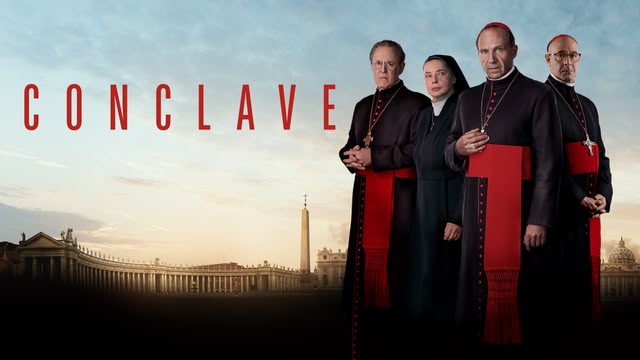

In a world where even the Vatican isn’t immune to the stench of political intrigue, Conclave (2024) arrives like a quiet but scorching indictment of institutional manipulation draped in holiness. Directed by Edward Berger and based on the best-selling novel by Robert Harris, the film dives deep into the hallowed halls of Catholic power — and what lies beneath is as far from divine as it gets. If House of Cards ever had a Vatican spin-off, this would be it, minus the sex but brimming with cold-blooded scheming and moral ambiguity.
Ralph Fiennes stars as Cardinal Lomeli, a man caught in the political and spiritual crossfire after the sudden death of a fictional Pope. Lomeli is no smooth operator — not a wolf in sheep’s clothing, but a lamb slowly realizing he’s surrounded by wolves. What makes his performance magnetic is precisely that: the calm integrity of a man who wants to do the right thing while everyone around him sharpens their daggers under their cassocks.

Holy Smoke, It’s Still Politics
The core of the film is the papal conclave — a secretive, centuries-old ritual where cardinals from around the world gather in the Sistine Chapel to elect the new Pope. Supposedly, this is a spiritual endeavor guided by prayer and reflection. But Conclave peels back the incense to reveal what really drives the process: alliances, blackmail, and ideological war.
Catholicism, in this movie, is not just a religion. It’s a multinational corporation with centuries of political experience, fighting a cultural cold war between conservative dogma and progressive reform. The cardinals aren’t monks — they’re power brokers with decades of clerical baggage, ideological grievances, and hidden skeletons. One even wonders if any of them actually believe in God or just believe in winning.
And here’s where the film hits hard — it shows that the Vatican, while wrapped in velvet and tradition, is still another institution where morality is traded for power, secrets are weaponized, and truth is just a tool. You could easily replace the cardinals with senators or CEOs and the dynamics would remain unchanged. Berger isn’t just telling a story about Catholicism — he’s showing us how power works when everyone wears a mask and calls it virtue.

Fiennes, Subtle Yet Surgical
Ralph Fiennes deserved the Oscar for this role. He underplays it — which makes it all the more powerful. There’s a tremble in his silence, a burden in his gaze, as he realizes that faith isn’t enough when the system itself is corrupted. And yet, he doesn’t fall into the trap of the self-righteous martyr. He navigates the maze, confronts his own conscience, and takes bold steps without ever resorting to cheap theatrics. It’s restrained brilliance.
His counterparts — played expertly by Stanley Tucci, John Lithgow, and Sergio Castellitto — bring different shades of ambition and deceit to the table. Lithgow, in particular, plays a conservative candidate who practically salivates at the idea of rolling back modernity in the name of tradition. Sound familiar? (Cough — political parties in most democracies today.)

Religion, Modernity, and the Crisis of Belief
What elevates Conclave beyond a well-acted political thriller is its deeper commentary on the Church’s identity crisis. It’s a mirror for modern institutions everywhere — should they adapt to changing values or cling to foundational beliefs, no matter how outdated or unpopular? This isn’t a movie that answers that question. It just forces you to confront it — especially if you’re someone (like me) who respects faith but distrusts organized religion. It makes you wonder: how many other sacred institutions are built on equally shaky foundations? What happens when those sworn to be moral shepherds are more interested in becoming kings? The film also deserves credit for not indulging in atheist-bashing or cheap shots at Catholicism. It walks a very fine line, respecting the power of faith while damning the rot that power invites. That’s rare in cinema — and refreshing.
Conclave is a film that doesn’t shout. It whispers — and yet every whisper echoes. Ralph Fiennes anchors a drama that isn’t about action or spectacle, but about conviction, compromise, and the quiet decay of institutions that claim to be eternal. It’s intelligent, deliberate, and unsettling — the kind of movie that lingers long after the credits roll. Not because it reveals something new, but because it reminds us what we’ve always known: when power wears a halo, it becomes even more dangerous.

JAY’S VERDICT
If you’re tired of Marvel-tier explosions and emotionally dead blockbusters, go watch Conclave.